
 Call Us Now !
Tel : +86 755 27374946
Call Us Now !
Tel : +86 755 27374946
 Order Online Now !
Email : info@bichengpcb.com
Order Online Now !
Email : info@bichengpcb.com
AI Demand Surge Opens Window for Domestic High-End Materials
AI Demand Surge Opens Window for Domestic High-End Materials
Recently, the copper clad laminate (CCL) sector has been showing sustained strength in the stock market. Data shows that since April 1, the share price of Fangbang Electronics (688020) has risen nearly 100%; the share prices of several other CCL-listed companies, including Shengyi Technology (600183) and Nanya New Material (688519), have also continued to climb.
Behind the stock price increases, the rapidly growing demand for AI servers and high-speed switches is pushing the CCL industry into a supply shortage cycle. A Shanghai Securities News reporter learned that delivery times for some high-end CCL products have already been extended to more than two weeks. At the same time, key raw materials such as HVLP copper foil and low-dielectric electronic glass fabric are facing persistent supply tightness, and the supply shortage of overseas high-end materials is opening a window for domestic raw material suppliers to enter the high-end supply chain.
Delivery times for high-end CCL continue to lengthen
Multiple industry chain sources told reporters that compared to traditional servers, AI servers have higher requirements for signal transmission speed, loss control, and heat dissipation capability, which has led to rapidly growing demand for high-end CCL.
Against this backdrop, delivery times for high-end CCL have begun to lengthen. Xiong Yiyu, a senior electronics analyst at Huachuang Securities, said in an interview that delivery times for standard CCL products remain around 7 to 10 days, while delivery times for AI-related and high-speed high-grade materials have generally been extended to more than two weeks.
"Currently, delivery times for mainstream M8 high-speed materials are 3 to 4 weeks, and delivery times of more than 6 weeks are mainly concentrated on certain special grades and substrate materials," Xiong said.
A board secretary of a CCL listed company told reporters that the industry's average delivery time has generally lengthened from the normal level of about 7 days to 15–20 days, and some manufacturers have extended delivery times to as long as 20–30 days.
The secretary said that current orders related to high-end AI are growing rapidly, and the production processes for these products are more complex and take longer, occupying significantly more capacity than ordinary products, further exacerbating the supply shortage.
In Xiong's view, the core reasons for the extended delivery times are: on the one hand, CCL manufacturers currently have relatively high overall capacity utilization; on the other hand, delivery times for upstream core raw materials such as electronic glass fabric and copper foil are also significantly lengthening, forcing CCL manufacturers to passively extend their delivery cycles.
A research report from Shanxi Securities shows that the AI-driven super-cycle will remain in a high-growth phase for the next 3 to 5 years, thereby providing sustained strong demand for high-end CCL. It is expected that the tight supply-demand situation for CCL will persist until 2027 or even longer.
Upstream raw material supply tightens
"The core supply-demand contradiction currently lies not in CCL itself, but in electronic glass fabric and copper foil," Xiong said.
With the rapid growth in demand for AI servers and high-speed switches, demand for high-end materials such as HVLP copper foil and low-dielectric electronic glass fabric has risen sharply. It is understood that next-generation AI chips and server platforms from tech giants such as Amazon (AMZN), NVIDIA (NVDA), and Google will enter mass production intensively in the second half of 2026, further amplifying demand for HVLP4 copper foil, a core substrate material.
From the perspective of industry supply structure, this round of raw material shortage is not purely driven by demand growth; the core issue lies in the fact that the pace of high-end capacity release is significantly lagging behind AI demand growth.
A chief analyst in the electronics sector at a securities firm told reporters that this is mainly because high-end capacity reserves were insufficient in the past. "Originally, capacity was prepared for consumer electronics and industrial products, with not so much demand from servers. But over the past two years, demand has surged." Expanding high-end material capacity is significantly more difficult than for ordinary products, with cycles often lasting 18 to 24 months from equipment procurement and production line commissioning to customer certification.
The board secretary of the aforementioned CCL listed company told reporters that some high-end materials have now adopted a "quota supply" model, where manufacturers prioritize meeting the needs of core customers, while some small and medium-sized customers must wait in line for delivery.
A research report from Shanxi Securities shows that for key equipment such as Toyota looms (needed to produce electronic glass fabric), global delivery lead times have exceeded one year, significantly restricting the expansion of high-end electronic glass fabric capacity. HVLP copper foil, due to high technical barriers and concentration among a few manufacturers, also has a long capacity expansion cycle. The institution expects that the supply-demand gap for high-end HVLP copper foil will persist through 2026 to 2027.
A window opens for domestic high-end materials
Against the backdrop of tightening supply of overseas high-end materials, the domestic supply chain is facing a significant window of opportunity.
"In the past, high-end HVLP copper foil and high-frequency,high-speed materials were long dominated by suppliers from Japan and other regions. In particular, overseas top-tier customers have extremely high supply chain certification requirements, making it difficult for domestic manufacturers to enter the core system," Xiong said.
But this situation is changing. Currently, some leading CCL manufacturers are accelerating the introduction of domestic copper foil supply chains and actively supporting local players in testing and certification. Some domestic copper foil manufacturers are now able to supply third-generation HVLP products in small volumes, while fourth-generation products are still in the certification stage; some manufacturers have passed certification but have not yet started large-scale delivery.
On May 8, Tongguan Copper Foil (301217) stated at its 2025 annual performance briefing: "The company has completed customer supply layout for its full series of HVLP copper foils, with current shipments mainly dominated by HVLP 2nd generation products; HVLP 5th generation copper foil is under development, and key performance indicators have already been achieved."
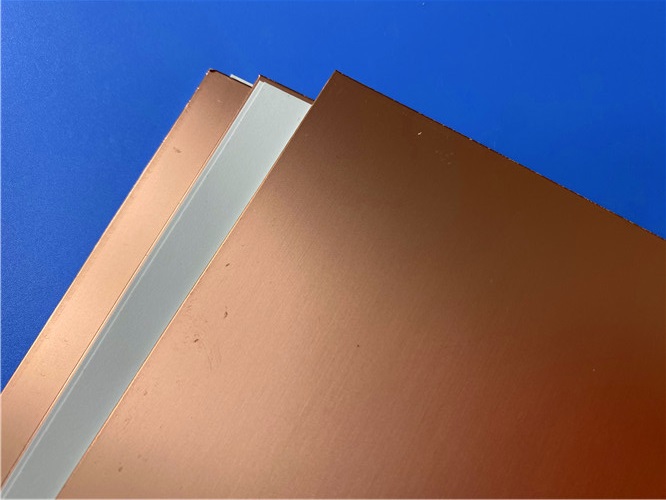
For example, a domestic advanced material–TP1600 high-Dk CCL –offers a compelling solution for demanding RF and microwave applications. It features a dielectric constant (Dk) of 16.0±0.32, a low dissipation factor (Df) of 0.0012, and excellent TcDk of -43 ppm/°C. The non-fiberglass structure ensures a smooth surface and eliminates glass-weave effects. Ideal for miniaturized antennas, aerospace, defense, and satellite payloads, Wangling TP1600 also supports easier machining (drilling, grinding) than pure ceramics, with reflow soldering limited to≤200°C. This product demonstrates how domestic innovation is ready to serve high-reliability, high-frequency markets.
In the eyes of industry insiders, the demand driven by this round of AI servers brings not only a cyclical "volume and price increase" but also a high-end upgrade of the entire CCL material system. In the past, the industry competed more on price and scale. In the AI era, what determines a supplier's competitiveness is shifting toward the ability to supply high-end materials, the capability for technological iteration, and the ability to enter core supply chain systems.
 6-11C Shidai Jingyuan, Fuyong, Baoan, Shenzhen, Guangdong, China 518103


For inquiries about our products or pricelist, please leave to us and we will be in touch within 24 hours.
© Copyright: 2026 Shenzhen Bicheng Electronics Technology Co., Ltd.. All Rights Reserved.

IPv6 network supported


