
 Call Us Now !
Tel : +86 755 27374946
Call Us Now !
Tel : +86 755 27374946
 Order Online Now !
Email : info@bichengpcb.com
Order Online Now !
Email : info@bichengpcb.com
How Does RO4350B LoPro PCB Solve Conductor Loss Issues in High-Speed Electronics?
How Does RO4350B LoPro PCB Solve Conductor Loss Issues in High-Speed Electronics?
As electronic systems push toward millimeter-wave frequencies and data rates exceeding 100 Gbps, conductor loss has emerged as the single most critical bottleneck limiting performance. In 5G mmWave base stations, satellite communication payloads, and high-speed data center backplanes, even a 0.1 dB/inch increase in signal attenuation can translate to 10% shorter coverage range or a doubling of bit error rates. While standard high-frequency materials like conventional Rogers RO4350B represented a major advancement over FR-4, they still struggle with excessive conductor loss at frequencies above 20 GHz. RO4350B LoPro PCB addresses this fundamental limitation through a proprietary copper foil technology that delivers up to 30% lower conductor loss without sacrificing manufacturability or reliability.
The Physics of Conductor Loss: Why Surface Roughness Matters
To understand how RO4350B LoPro solves conductor loss issues, it is first necessary to examine the underlying physical principles. At high frequencies, alternating current does not flow uniformly through the entire cross-section of a copper conductor. Instead, it concentrates in a thin layer near the surface—a phenomenon known as the skin effect. The depth of this layer, called the skin depth, decreases inversely with the square root of frequency.
At 10 GHz, the skin depth in copper is approximately 0.66μm. At 40 GHz, it shrinks to just 0.33μm—less than the thickness of a human hair. This means that at mmWave frequencies, virtually all signal current flows within the top 0.5μm of the copper foil. Consequently, the surface roughness of the copper becomes the dominant factor in determining conductor loss, far outweighing dielectric loss in many applications.
Standard electrodeposited copper foils used in conventional RO4350B laminates have a surface roughness of approximately 2.0μm RMS—more than six times the skin depth at 40 GHz. The irregular peaks and valleys on the foil surface cause signal scattering, reflection, and absorption, significantly increasing attenuation. This roughness also introduces signal phase distortion and is a primary source of passive intermodulation (PIM) in wireless communication systems.
The RO4350B LoPro Breakthrough: Reverse-Treated Foil Technology
RO4350B Low Profile laminates solve the conductor loss problem through a revolutionary bonding process developed by Rogers Corporation. Unlike standard RO4350B, which uses conventional electrodeposited copper foils, RO4350B LoPro incorporates reverse-treated foil (RTF) that is specially engineered to have an extremely smooth surface while maintaining excellent adhesion to the dielectric material.
The proprietary Rogers technology modifies the copper foil surface to achieve a roughness of less than 0.6μm RMS—more than three times smoother than standard copper foils. This dramatic reduction in surface roughness directly translates to lower conductor loss. Independent testing has shown that RO4350B LoPro reduces overall insertion loss by up to 30% compared to standard RO4350B at frequencies above 20 GHz. At 40 GHz, this difference amounts to approximately 0.5 dB/inch—a significant improvement that can make the difference between a working design and one that fails to meet performance specifications.
Crucially, this performance enhancement does not come at the expense of the other desirable properties that have made RO4350B the industry standard for high-frequency applications. RO4350B LoPro maintains the same stable dielectric constant of 3.48±0.05 at 10 GHz and 23°C, with minimal variation across temperature and frequency ranges. It also retains the low dissipation factor of 0.0037 at 10 GHz, ensuring that dielectric loss remains negligible even at extremely high frequencies.
Beyond Lower Loss: Cascading Performance Benefits
The reduction in conductor loss provided by RO4350B LoPro creates a cascade of additional performance benefits that improve overall system reliability and efficiency.
First, the smoother copper surface significantly reduces passive intermodulation (PIM) levels. PIM is a critical issue in cellular base stations, where it can cause interference between different frequency bands and degrade network performance. RO4350B LoPro's low PIM characteristics make it the material of choice for antenna elements and power amplifiers in 5G and 4G LTE networks.
Second, lower conductor loss means less energy is converted into heat during signal transmission. This improved energy efficiency, combined with RO4350B LoPro's high thermal conductivity of 0.69 W/mK (more than twice that of standard FR-4), helps dissipate heat more effectively, reducing hotspots and extending the lifespan of electronic components. This is particularly important for high-power applications such as base station power amplifiers, where thermal management is a major design challenge.
Third, RO4350B LoPro offers excellent dimensional stability and thermal expansion matching. Its X-axis coefficient of thermal expansion (CTE) is 10 ppm/°C, Y-axis is 12 ppm/°C, and Z-axis is 32 ppm/°C—values that closely match the CTE of copper (approximately 17 ppm/°C). This close matching minimizes thermal stress on plated through-holes, significantly reducing the risk of via cracking and improving long-term reliability, even in applications exposed to extreme temperature variations from -55°C to 288°C.
Manufacturing Advantages That Make High Performance Accessible
One of the most significant advantages of RO4350B LoPro over competing low-loss materials is its compatibility with standard FR-4 manufacturing processes. Unlike PTFE-based materials, which require specialized equipment, sodium etch via preparation, and extended processing times, RO4350B LoPro can be fabricated using the same equipment and processes used for standard epoxy-glass PCBs. This compatibility translates directly to lower manufacturing costs and shorter lead times, making high-frequency performance accessible to a wider range of applications.
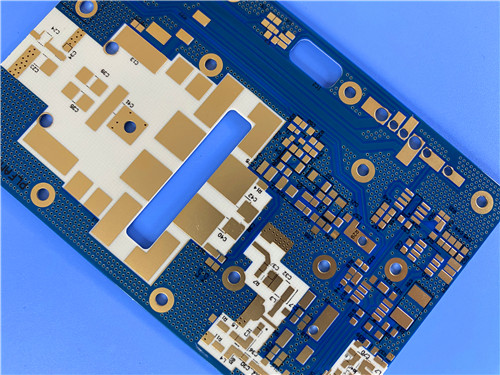
At Bicheng PCB, we have extensive experience manufacturing RO4350B LoPro PCBs with tight tolerances and complex designs. Our standard 2-layer RO4350B LoPro PCB measures 78mm x 101mm and features a finished thickness of just 0.2 mm, making it ideal for compact high-frequency modules. We can achieve minimum trace/space of 5/6 mils and minimum hole sizes of 0.25 mm, with 1 oz (35μm) outer copper layers and 20μm via plating thickness for reliable electrical connections.
All our RO4350B LoPro high freqeuncy PCBs are manufactured to IPC-Class-2 standards and undergo 100% electrical testing prior to shipment to guarantee performance. We accept Gerber RS-274-X artwork files, the industry standard for PCB manufacturing, and offer worldwide shipping to customers across North America, Europe, Asia, and beyond. Our standard stackup consists of 35μm copper on both sides with a 4 mil (0.102 mm) thick RO4350B LoPro substrate, providing excellent signal integrity while maintaining mechanical stability.
Conclusion
RO4350B low profile PCB represents a significant advancement in high-frequency PCB technology, providing a comprehensive solution to the conductor loss problem that has long plagued high-speed electronic designs. By reducing copper foil surface roughness by more than 70% while maintaining all the desirable properties of standard RO4350B, it enables reliable operation at frequencies exceeding 40 GHz, improves PIM performance, enhances thermal management, and ensures long-term reliability.
At Bicheng PCB, we combine our expertise in high-frequency PCB manufacturing with the superior performance of RO4350B LoPro to deliver high-quality products that meet the most demanding requirements of the electronics industry. Whether you are designing 5G mmWave base stations, satellite communication systems, or high-speed data center equipment, RO4350B LoPro PCB from Bicheng PCB is the ideal solution for your high-frequency design challenges.
Categories
New Blog
Tags
 6-11C Shidai Jingyuan, Fuyong, Baoan, Shenzhen, Guangdong, China 518103


For inquiries about our products or pricelist, please leave to us and we will be in touch within 24 hours.
© Copyright: 2026 Shenzhen Bicheng Electronics Technology Co., Ltd.. All Rights Reserved.

IPv6 network supported


