
 Call Us Now !
Tel : +86 755 27374946
Call Us Now !
Tel : +86 755 27374946
 Order Online Now !
Email : info@bichengpcb.com
Order Online Now !
Email : info@bichengpcb.com
Blog
Why Use Tg170 TU-768 FR-4 Cores in a 10-Layer RO4350B Hybrid PCB? When a 10-layer RF module is quoted as a pure ceramic build, the bill of materials can look unreasonable for a volume product. The better engineering response is to ask which layers actually need the high-frequency dielectric. In a 10-layer RO4350B + TU-768 hybrid PCB, the two outer-facing cores use10 mil (0.25 mm) RO4350B hydrocarb...
Can One Rogers RO4003C 1100x350mm Double-Sided HF PCB Replace Spliced Antenna Sub-Boards? 1. The short answer Yes. When a single radiating aperture, feed network or sensor array is longer than a standard board and must stay electrically continuous, one Rogers RO4003C 1100x350mm double-sided HF PCB removes the connectors and splices that quietly degrade large antenna designs. It is not the che...
How to Select 1080 Prepreg for Rogers RO3010 and FR-4 Hybrid Lamination? Introduction Hybrid multilayer PCBs that pair ceramic-filled PTFE high-frequency laminates such as Rogers RO3010 with conventional FR-4 prepreg have become a standard construction for cost-sensitive RF designs. Place the premium high-Dk material only where RF signals travel, and use economical FR-4 bonding sheets elsewhere. Y...
How Do You Build an 8-Layer RO4350B MT40 Hybrid PCB Without Defects? A hybrid stack looks elegant on a cross-section drawing. It promises the low-loss, tightly controlled RF behavior of a ceramic-loaded hydrocarbon laminate on the outer layers, and the cost and processing familiarity of an FR-4-type low-loss material in the middle. On paper, that is exactly what an 8-Layer RO4350B MT40 Hybrid PCB ...
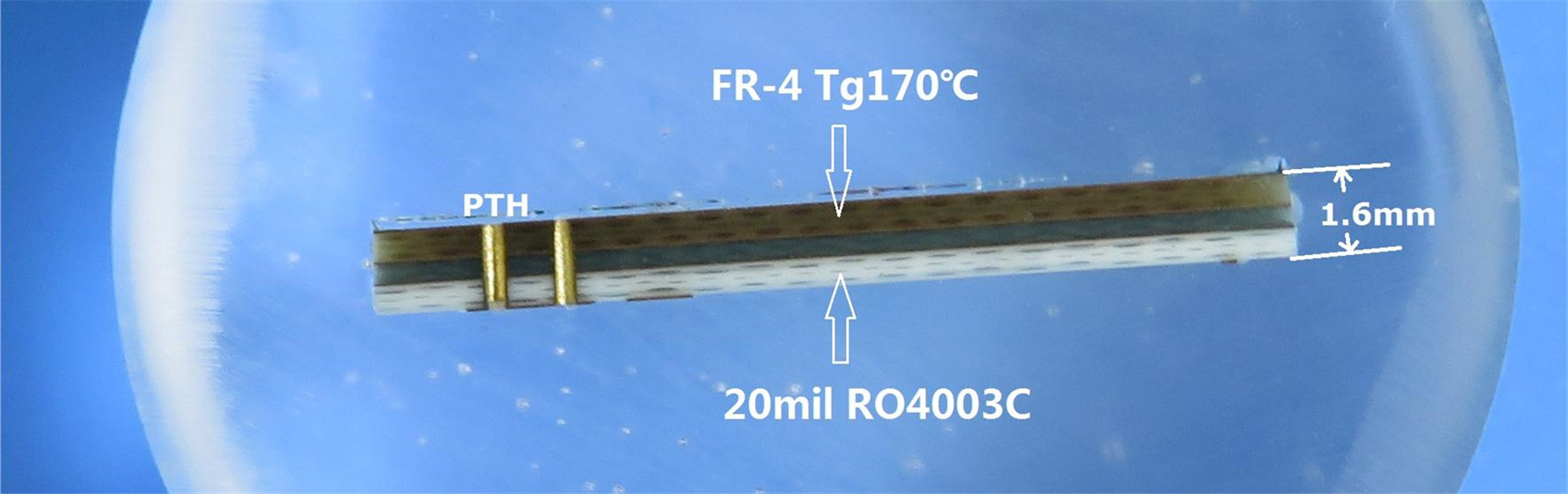
Is a 4-Layer 8mil RO4003C Tg170 FR-4 Hybrid PCB Right for You? Every mixed-signal design eventually reaches the same decision. One section of the board carries RF or microwave traces — antenna feeds, matching networks, a front-end that must hit a defined impedance — while the rest is ordinary power and digital control. The material question follows immediately: all FR-4, all high-frequency laminat...
Why Does an 8mil ENEPIG High-Frequency PCB Matter for RF Design? Meta Description: An engineering deep-dive into WL-CT615 hydrocarbon-ceramic PCB with 8mil dielectric core and ENEPIG finish — material data, design trade-offs, and application guidance for RF and hardware engineers. RF engineers face a persistent tension: shrinking form factors versus signal integrity. When a board must fit into an ...
Why Choose a 4-Layer 5mil RT6202+FR-4 Hybrid PCB for High-Frequency RF Designs? Introduction When designing RF and microwave circuits above 3 GHz, engineers face a persistent dilemma: standard FR-4 substrates introduce unacceptable signal loss and dielectric instability, while fully Rogers-based multilayer boards carry prohibitive material costs for digital and power sections. A 4-layer 5mil RT620...
Dk 3.0 or Dk 10.2: Which High-Frequency Substrate Fits Your Antenna Design? Quick Answer Choose Dk 3.0 for wider traces, easier impedance control, and higher-frequency operation where dispersion matters. Choose Dk 10.2 for circuit miniaturization, compact antenna spacing, or high-Dk architectures. TFA1020, a PTFE-ceramic composite with no glass fiber, delivers Dk 10.2 at 10 GHz with Df as low as 0...
Which RF Applications Suit TF960 PCB? A Dk 9.6 Low-Loss Selection Guide Quick Answer TF960 PCB is a high-frequency laminate made from modified PTFE resin, ceramic fillers, and glass fabric. With a dielectric constant (Dk) of 9.6 ± 0.19 and dissipation factor (Df) of 0.0012 at 10 GHz, it targets RF and microwave circuits requiring low insertion loss and stable impedance. It supports 260°C lead-free...
What Makes F4BTD350S PCB the Right Choice for High-Power RF Designs? Quick Answer The F4BTD350S PCB is a PTFE-based high-frequency circuit board engineered explicitly for high-power radio frequency (RF) and microwave applications where thermal management and signal integrity are non-negotiable. Built on a glass-fiber-reinforced PTFE substrate loaded with high-thermal-conductivity ceramic fillers, ...
Categories
New Blog
Tags
 6-11C Shidai Jingyuan, Fuyong, Baoan, Shenzhen, Guangdong, China 518103


For inquiries about our products or pricelist, please leave to us and we will be in touch within 24 hours.
© Copyright: 2026 Shenzhen Bicheng Electronics Technology Co., Ltd.. All Rights Reserved.

IPv6 network supported


