
 Call Us Now !
Tel : +86 755 27374946
Call Us Now !
Tel : +86 755 27374946
 Order Online Now !
Email : info@bichengpcb.com
Order Online Now !
Email : info@bichengpcb.com
How a 150mil TMM13i PCB Resolves the Hidden Reliability Crisis in RF Design?
How a 150mil TMM13i PCB Resolves the Hidden Reliability Crisis in RF Design?
When a satellite link drops a packet or a chip tester misreads a signal, the root cause is rarely traced back to the material science of a printed circuit board. Yet, in high-frequency engineering, the choice of substrate is often the silent arbiter between a robust product and a field failure. Among the specialized laminates available, the TMM13i PCB stands as a curious outlier—a ceramic thermoset composite that refuses to behave like standard PTFE while solving very specific mechanical and thermal problems. This article explores why this rigid, 150mil-thick, 2-layer configuration is gaining quiet but decisive traction in reliability-critical RF paths.
Beyond Standard PTFE: Why a Thermoset Microwave Material Changes the Rules
Many RF engineers are conditioned to reach for PTFE-based laminates for microwave circuits. These materials offer excellent electrical performance but introduce well-known fabrication headaches: cold flow under clamping pressure, dimensional instability during thermal cycling, and a mandatory sodium naphthalate etch before electroless plating. The TMM13i laminate, developed by Rogers, disrupts this paradigm by basing its chemistry on an isotropic ceramic thermoset polymer composite.
The immediate practical upside is structural stability. The mechanical properties of TMM13i resist creep and cold flow, meaning that a plated through-hole barrel or a tightly coupled stripline gap does not mechanically relax over time. This is not a cosmetic benefit; in a2-layer TMM13i PCBdesigned for dielectric lenses or high-power couplers, any substrate deformation translates directly into a phase shift or impedance mismatch. When your dielectric constant is specified at 12.85±0.35—a notably high Dk—keeping that value stable across the board’s lifetime is paramount.
Decoding the 150mil Thickness: When a 3.81mm Substrate Makes Perfect Sense
A 150mil (3.81mm) thick core sounds excessive for a simple 2-layer board. In the realm of standard digital PCBs, thickness is often about mechanical rigidity. In a TMM13i PCB, the heavy dielectric thickness serves an entirely different, frequency-dependent purpose.
Consider a microstrip directional coupler or a dielectric polarizer at C-band or X-band. The combination of a high dielectric constant (approximately 12.85) and a thick substrate enables practical line widths and gaps that can be etched reliably with 35μm copper. If you simulate the same structure on a 30mil laminate, the conductive traces shrink to impractical dimensions, increasing insertion loss and making etching tolerances unmanageable for standard IPC-Class-2 processing. The 150mil TMM13i stackup—Copper_layer_1 (35μm), TMM13i (3.81mm), Copper_layer_2 (35μm)—allows a strip-line or micro-strip design to breathe. Trace widths remain manufacturable, coupling factors remain repeatable, and the board becomes a scalable component rather than a laboratory curiosity.
The Thermal Coefficient Mismatch That No Longer Exists
One specification buried in most datasheets is the coefficient of thermal expansion (CTE) mismatch between the substrate and copper. A large Z-axis CTE difference causes via barrels to crack during lead-free reflow or over the–55 to 288°C operational gradients required in satellite and military applications. The TMM13i material specifies an X-axis and Y-axis CTE of 19 ppm/°C, a Z-direction CTE of 20 ppm/°C, and a thermal coefficient of Dk of -70 ppm/°K.
This near-copper-matched expansion is fundamental. In a plated through-hole TMM13i PCB, the via wall experiences minimal shear stress during thermal shock. For applications like chip testers, where a board may cycle thousands of times between ambient and 125°C while maintaining precise 50Ωor 25Ω paths, this CTE harmony prevents stair-step cracks that plague alternative high-Dk laminates. The 94V-0 flammability rating further broadens the scope to indoor telecommunications infrastructure where fire safety codes are strict.
Fabrication Without Sodium Naphthalate: A Manufacturing Edge You Feel in Yield
PTFE microwave materials demand a wet chemical etching step using sodium naphthalate to make the surface wettable for electroless copper. It is a hazardous, time-sensitive process that can attack the resin if over-applied. TMM13i eliminates this requirement entirely because its thermoset resin surface is inherently receptive to electroless plating after standard desmear and preparation.
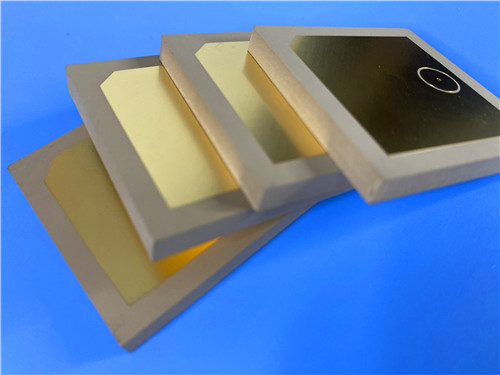
What this translates to for a PCB supplier is tighter process control and higher first-pass yield on a 2-layer ENIG TMM13i PCB. The supplied artwork (typically Gerber RS-274-X) can proceed through electroless nickel immersion gold plating without the variable introduced by that aggressive pre-treatment. The immersion gold surface, in turn, guarantees a flat, solderable finish compatible with lead-free assembly and, critically, with thermosonic wire-bonding. The product specification explicitly highlights reliable wire-bonding because the thermoset matrix provides a firm, non-rebounding pad under ultrasonic scrubbing—something no soft PTFE can claim without a thick, engineered surface finish.
Where the TMM13i PCB Becomes Irreplaceable: From Lenses to Satellite Filters
The applications listed for this material are not generic“RF circuits.”They are components where geometry and dielectric constant define the entire function:
Dielectric polarizers and lenses: These are shaped substrates where the board itself forms part of an antenna beamforming network. A 150mil thick, ultra-stable Dk panel can be milled or etched to create a planar lens with precise phase delay. Any Dk variation across the panel causes phase errors; the isotropic nature of Rogers TMM13i ensures consistent behavior in all three axes.
Filters and couplers: High-Dk substrates reduce the physical size of distributed filters. A parallel-coupled line bandpass filter on a 12.85 Dk material is dramatically smaller than its low-Dk counterpart, yet the thick 150mil substrate prevents the coupled gaps from becoming so tiny that solder mask or surface finish thicknesses would perturb the response.
Chip testers: The interface between a semiconductor wafer prober and the test equipment demands absolute signal integrity with no material-induced anomalies. The low dissipation factor of 0.0019 at 10GHz keeps insertion losses minimal, while the mechanical creep resistance ensures the contact pitch remains unchanged after thousands of probe touchdowns.
For satellite communication systems, where every gram of payload matters, replacing a bulky metallic waveguide structure with a lightweight, high-performance TMM13i PCB is a proven architectural shift. The material’s resistance to process chemicals also means it withstands the aggressive cleaning procedures sometimes required for space-bound hardware.
From a procurement standpoint, worldwide availability means that OEMs and CEMs in Europe, North America, and Asia can source these boards without extended lead-time penalties. As a PCB trading supplier, we have observed a steady cadence of inquiries for 2-layer TMM13i configurations specifically at the 150mil thickness; they are rarely stocked and almost always built to a custom RF layout. Having a reliable conduit for Rogers TMM13i, certified by material traceability, keeps prototyping and production schedules intact.
Closing Thoughts: Selecting the Right Board Before It Selects Your Failure
A TMM13i high frequency PCB is not an every-project choice. It is purpose-built for the moment when a standard RF laminate fails mechanically, or when a high Dk is needed in a thick, stable format. Its benefits—non-reliance on sodium treatment, isotropic Dk, copper-matched CTE, and creep resistance—converge to solve a set of problems that purely electrical datasheets often overlook. When the next design brief calls for a dielectric lens, a precise satellite filter, or a repeatable test interface, specifying a 150mil TMM13i 2-layer ENIG board might quietly save the project from the physics of material fatigue.
In an industry that chases signal speed, it is the stations that remain unchanged under stress that deliver the truest performance.
Categories
New Blog
Tags
 6-11C Shidai Jingyuan, Fuyong, Baoan, Shenzhen, Guangdong, China 518103


For inquiries about our products or pricelist, please leave to us and we will be in touch within 24 hours.
© Copyright: 2026 Shenzhen Bicheng Electronics Technology Co., Ltd.. All Rights Reserved.

IPv6 network supported


