
 Call Us Now !
Tel : +86 755 27374946
Call Us Now !
Tel : +86 755 27374946
 Order Online Now !
Email : info@bichengpcb.com
Order Online Now !
Email : info@bichengpcb.com
Is TFA294 PCB the Optimal Solution for Your High-Frequency RF Design Projects?
Is TFA294 PCB the Optimal Solution for Your High-Frequency RF Design Projects?
Quick Answer
For high-frequency RF designs operating up to 40 GHz that demand stable dielectric performance across extreme temperatures and aerospace-grade reliability, TFA294 PCB is an excellent solution. Its PTFE-ceramic composite construction delivers a consistent Dk of 2.94, ultra-low dissipation factor, and near-copper CTE values, making it particularly well-suited for phased array antennas, airborne radar systems, and satellite communications equipment where frequency stability and long-term reliability are non-negotiable.
Key Takeaways
1.Understanding the Demands of Modern High-Frequency PCB Design
2.TFA294 Material Architecture and Manufacturing Approach
What distinguishes TFA294 from many competing high-frequency laminates is its manufacturing methodology. Unlike traditional PCB substrates that impregnate glass fiber cloth with resin to form prepreg sheets, the Wangling TFA series employs a fiber-free production process. Nano-scale ceramic particles are uniformly dispersed throughout the PTFE resin matrix using a proprietary mixing and forming process, creating a homogeneous dielectric core without woven reinforcement.
This glass-fiber-free construction has several profound implications for electrical performance:
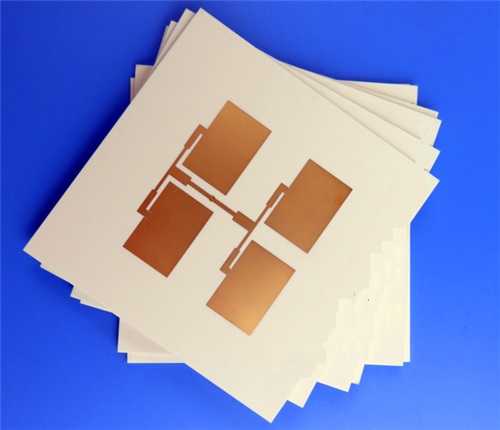
The 2-layer TFA294 PCB stackup commonly specified for antenna and microwave circuits consists of 35μm copper foil on both sides, with a 1.016 mm 40 mil TFA294 core dielectric. This configuration provides a robust mechanical platform while supporting controlled-impedance transmission lines in the 50–75 ohm range typical for RF systems.
3.Core Electrical Performance: Data and Engineering Significance
The electrical specifications of TFA294 are not just numbers on a datasheet—each parameter directly translates to measurable system-level performance.
3.1 Dielectric Constant (Dk) and Frequency Stability
3.2 Temperature Coefficient of Dielectric Constant (TCDK)
3.3 Thermal and Mechanical Reliability Characteristics
3.4 Coefficient of Thermal Expansion (CTE)
TFA294 delivers CTE values of 18 ppm/°C in both the X and Y axes, and 32 ppm/°C in the Z axis, measured across -55°C to 288°C. The in-plane values are remarkably close to copper's CTE of approximately 17 ppm/°C, which means that during reflow soldering and thermal cycling, the substrate and copper traces expand and contract at nearly identical rates.
This matching produces two major reliability benefits:
3.5 Thermal Conductivity and Environmental Resistance
4. Real-World Application Scenarios
Based on field deployment experience, TFA294 PCBs have demonstrated strong performance in several specific application categories.
4.1 Airborne and Early Warning Radar Systems
Radar front-end circuits require consistent phase response across temperature to maintain target tracking accuracy. One avionics manufacturer replaced a glass-reinforced PTFE substrate with TFA294 in an airborne weather radar antenna feed network, reporting a 40% reduction in phase drift across the -40°C to +85°C operating range. The isotropic material properties also simplified the design of the corporate feed network, as engineers no longer needed to compensate for Dk variations between horizontal and vertical trace runs.
4.2 Phased Array Antennas and Beamforming Networks
In phased array systems, each antenna element must exhibit nearly identical electrical characteristics to ensure precise beam steering. TFA294's uniform ceramic dispersion eliminates the Dk "knitting pattern" effect seen in woven substrates, enabling element-to-element phase matching within tighter tolerances. This is particularly valuable for active electronically scanned arrays (AESAs) used in defense and satellite communications ground stations.
4.3 Satellite Communications and Navigation Receivers
Satellite links operate at extremely low signal levels, making receiver sensitivity paramount. TFA294's low dissipation factor minimizes insertion loss in the RF front-end filter and matching networks, directly improving noise figure and extending link budget. The material's radiation resistance and temperature stability also align with the demands of space-borne and ground-based satellite infrastructure.
4.4 High-Frequency Power Amplifiers
While not a thermal management substrate per se, TFA294's combination of low loss and moderate thermal conductivity makes it suitable for medium-power amplifier designs in the 1–40 GHz range. Designers typically use 35μm copper (1 oz) as standard, with options for heavier copper for higher power handling.
5.Manufacturing Considerations for TFA294 PCBs
Working with PTFE-ceramic composites requires specialized PCB fabrication processes that differ from standard FR-4 production.
The ceramic filler content increases material hardness, requiring optimized drilling parameters—typically lower feed rates and specialized drill bit geometries—to prevent excessive tool wear and avoid delamination around hole walls. Plasma treatment of drilled holes is standard practice to improve PTH adhesion, as the inert PTFE surface does not readily accept electroless copper deposition without proper activation.
For 2-layer TFA294 PCBs with 1.016 mm core thickness, standard fabrication capabilities include minimum trace/space of 4/5 mil, mechanical drill diameters down to 0.2 mm, and surface finish options such as immersion gold (ENIG), immersion silver, and OSP. As with all high-frequency boards, tight impedance control requires precise copper thickness control and accurate dielectric thickness, so working with an experienced high-frequency PCB manufacturer is essential.
6.Frequently Asked Questions
How does TFA294 compare to Rogers RO3003?
TFA294 and RO3003 share similar ceramic-filled PTFE architectures and target overlapping frequency ranges. RO3003 offers a Dk of 3.00, very close to TFA294's 2.94, with comparable Df values. TFA294 differentiates itself through its glass-fiber-free construction, which provides more isotropic electrical behavior and eliminates weave-related signal skew. For designs where directional Dk variations could impact performance, TFA294 offers a meaningful advantage.
Can TFA294 be used in multilayer PCB constructions?
While the most common configuration is 2-layer, TFA294 can be incorporated into multilayer stackups when paired with compatible prepreg materials. However, multilayer PTFE-based PCBs require specialized lamination cycles and careful material matching to ensure reliable interlayer adhesion. For designs requiring mixed-signal integration, hybrid stackups combining TFA294 high-frequency layers with FR-4 digital layers are also feasible.
What is the lead time for TFA294 PCB prototyping?
Prototype lead times for 2-layer TFA294 PCBs typically range from 7 to 12 working days, depending on board complexity and required surface finish. This is slightly longer than standard FR-4 prototypes due to the specialized drilling and plasma treatment processes. Production volume lead times generally run 15–20 working days. Material availability can impact lead times, so it is advisable to confirm stock status with your PCB manufacturer at the quotation stage.
Is TFA294 RoHS compliant and suitable for commercial products?
Yes,TFA294 substrates are manufactured to meet RoHS compliance requirements and contain no restricted substances. Beyond consumer and commercial applications, the material's UL 94-V0 rating and environmental performance characteristics also support use in industrial, aerospace, and defense-grade electronic systems.
Final Assessment
TFA294 high frequency PCB occupies a valuable niche in the high-frequency substrate landscape. For engineers working on microwave antennas, radar systems, satellite communications, or any application where phase stability, low loss, and thermal resilience are critical, this glass-fiber-free PTFE-ceramic composite delivers performance that justifies its position as an aerospace-grade material option. Its well-balanced set of electrical, thermal, and mechanical properties, combined with the flexibility of the broader TFA series Dk options, gives design teams a reliable tool for pushing system performance at frequencies up to 40 GHz and beyond.
The key to success lies in partnering with a PCB manufacturer experienced in PTFE-ceramic material processing, who can ensure that the material's inherent performance advantages are fully realized in the finished board through proper drilling, metallization, and impedance control practices.
Categories
New Blog
Tags
 6-11C Shidai Jingyuan, Fuyong, Baoan, Shenzhen, Guangdong, China 518103


For inquiries about our products or pricelist, please leave to us and we will be in touch within 24 hours.
© Copyright: 2026 Shenzhen Bicheng Electronics Technology Co., Ltd.. All Rights Reserved.

IPv6 network supported


