
 Call Us Now !
Tel : +86 755 27374946
Call Us Now !
Tel : +86 755 27374946
 Order Online Now !
Email : info@bichengpcb.com
Order Online Now !
Email : info@bichengpcb.com
What Is WL-CT300 PCB? A Practical Guide to Low-Loss RF Substrates
What Is WL-CT300 PCB? A Practical Guide to Low-Loss RF Substrates
WL-CT300 PCB is a thermosetting high-frequency laminate from Wangling WL-CT series, composed of hydrocarbon resin, ceramic filler, and fiberglass cloth reinforcement. With a dielectric constant (Dk) of 3.00 and dissipation factor (Df) of 0.0025 at 10 GHz, it delivers FR-4-like manufacturability with performance approaching premium PTFE-based materials. It is widely used in base station antennas, automotive radar, power amplifiers, and satellite communication systems where low loss, thermal stability, and production yield are equally important.
Key Takeaways
1. Why Low-Loss Materials Matter in Modern RF Design
2. What Is WL-CT300 PCB? Material Composition Explained
WL-CT300 is part of Wangling's WL-CT series of organic polymer ceramic fiberglass cloth copper-clad laminates. Unlike PTFE-based materials that rely on polytetrafluoroethylene as the resin matrix, WL-CT300 uses a hydrocarbon resin system filled with ceramic particles and reinforced with woven fiberglass cloth.
This three-component system is carefully engineered:
-Hydrocarbon resin provides the base dielectric matrix with inherently low loss characteristics. Unlike epoxy-based FR-4 resins that have polar molecules that absorb electromagnetic energy, hydrocarbon resins are non-polar, resulting in much lower dissipation at high frequencies.
Ceramic filler is added to fine-tune the dielectric constant and improve thermal conductivity. The ceramic particles also enhance dimensional stability and reduce the coefficient of thermal expansion.
-Fiberglass cloth reinforcement provides mechanical strength and structural rigidity, similar to FR-4. This is what gives WL-CT300 its familiar handling characteristics and makes it compatible with standard PCB fabrication equipment.
-WL-CT300 is the Dk 3.00 variant in a broader family that includes Dk values of 3.30, 3.38, 3.48, 4.10, and 6.15. This range allows engineers to select the exact Dk that matches their impedance and design requirements, rather than being forced to compromise.
3. Core Electrical and Mechanical Properties (With Data)
Numbers only matter if you understand what they mean for your design. Here is a breakdown of WL-CT300's key specifications and their practical implications.
|
Parameter |
Value |
Engineering Significance |
|
Dielectric Constant (Dk) @ 10 GHz / 23°C |
3.00 ± 0.05 |
Low Dk enables wider transmission lines for a given impedance, reducing conductor loss and improving manufacturing tolerance |
|
Dissipation Factor (Df) @ 10 GHz |
0.0025 |
~8–10× lower loss than standard FR-4 (Df 0.02); comparable to Rogers RO4003C (Df 0.0027) |
|
Thermal Coefficient of Dk (TCDK) |
27 ppm/°C |
Dk changes by only 0.00081 per 10°C — critical for filter and oscillator frequency stability |
|
Glass Transition Temperature (Tg) |
> 280°C |
Far above standard FR-4 (Tg ~130–180°C); ensures dimensional stability during lead-free reflow |
|
Thermal Conductivity |
0.41 W/mK |
~30% higher than standard FR-4 (~0.3 W/mK); improves heat dissipation in power amplifier designs |
|
Moisture Absorption |
0.15% |
Very low moisture uptake prevents Dk drift in humid environments — essential for outdoor base station equipment |
|
CTE (X / Y / Z-axis) |
15 / 14 / 31 ppm/°C |
X/Y CTE closely matches copper (17 ppm/°C), minimizing stress on plated through-holes during thermal cycling |
To put the loss numbers in perspective: a 100 mm microstrip transmission line on FR-4 at 10 GHz would have approximately 1.5–2.0 dB of dielectric loss. The same line on WL-CT300 would have only 0.15–0.25 dB. That is an order of magnitude improvement, and it directly translates to better receiver sensitivity, higher transmitter efficiency, and lower thermal load.
4. WL-CT300 vs. Common Alternatives
Understanding how WL-CT300 compares to other materials helps you make the right selection.
FR-4 is cheap and widely available, but its loss becomes unacceptable above 1–2 GHz for most RF applications. WL-CT300 offers dramatically lower Df, better thermal stability, and tighter Dk tolerance. The trade-off is cost—WL-CT300 is more expensive than FR-4, but still far more affordable than premium PTFE laminates.
PTFE materials like Rogers RO4003C (Dk 3.38, Df 0.0027) have set the standard for high-frequency PCBs. However, they are expensive and difficult to manufacture. WL-CT300 offers similar electrical performance with a key advantage: it processes like FR-4. No plasma treatment, no special drill bits, no sodium naphthalene etching. This means faster turnaround times, higher yields, and lower fabrication costs—especially for prototypes and small-to-medium production runs.
WL-CT300 is part of a growing category of hydrocarbon ceramic laminates that includes materials like Isola IS680 and Panasonic Megtron6. What sets WL-CT300 apart is its combination of very low Dk (3.00), excellent Df (0.0025), and competitive pricing—particularly for customers in Asia who benefit from local manufacturing and shorter supply chains.
5. Real-World Applications and Design Cases
WL-CT300's balance of performance and manufacturability makes it suitable for a wide range of high-frequency applications.
5.1 Base Station Antennas and DAS
In 4G and 5G base station antennas, feed networks and power dividers must maintain consistent performance across temperature and humidity. WL-CT300's low TCDK (27 ppm/°C) and low moisture absorption (0.15%) ensure that antenna boresight and sidelobe levels stay within specification from–40°C to +85°C. The FR-4-like processing also means antenna manufacturers can use their existing PCB supply chain without retraining.
5.2 Automotive Radar and ADAS Sensors
77 GHz automotive radar modules demand extremely stable dielectric properties because even a tiny Dk shift can move the target detection range. WL-CT300's tight Dk tolerance (±0.05) and excellent thermal stability make it well-suited for radar feed networks and antenna arrays. Its high Tg (>280°C) also withstands the multiple reflow cycles common in automotive assembly.
5.3 Power Amplifiers and RF Modules
Power amplifiers generate significant heat, and thermal management is critical. WL-CT300's thermal conductivity of 0.41 W/mK—about 30% better than FR-4—helps spread heat away from active devices. Combined with its low loss, which reduces the amount of heat generated in the substrate itself, it is a practical choice for medium-power amplifier designs.
5.4 Satellite Communication and LNBs
Low-noise block downconverters (LNBs) and satellite receiver front-ends require low loss and stable Dk to maintain signal-to-noise ratio. WL-CT300's Df of 0.0025 at 10 GHz ensures minimal insertion loss in the RF front-end, while its stable TCDK prevents frequency drift as the dish heats up in direct sunlight.
6. Fabrication Insights: What We've Learned from Production
As a PCB fabricator with years of experience processing WL-CT series materials, we have gathered practical insights that are not always in the datasheet.
-Drilling: Standard carbide drills work perfectly. No special tooling is needed, unlike PTFE which often requires diamond-coated or high-helix drills. Feed and speed parameters are nearly identical to FR-4.
-Plating: Standard electroless copper + electroplating achieves reliable via adhesion. No plasma treatment or chemical etching is required to activate the dielectric surface—this is the single biggest manufacturing advantage over PTFE.
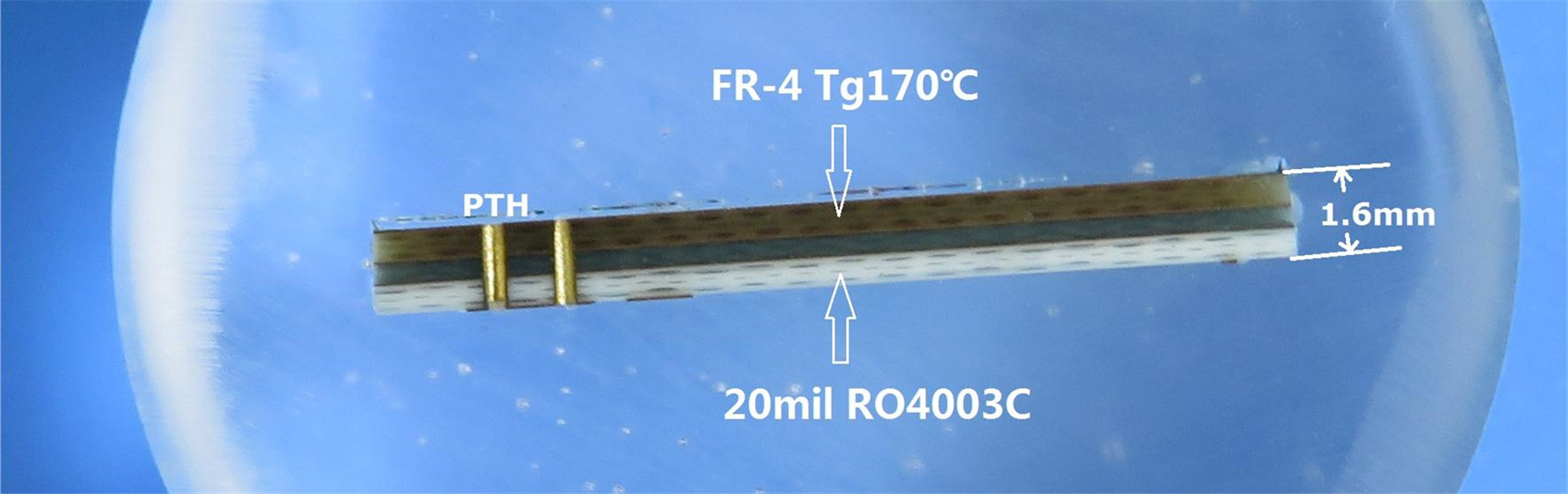
-Lamination: WL-CT300 is a thermoset material, so it uses standard lamination profiles. For multilayer designs, matching prepreg is available from Wangling, making it straightforward to build hybrid stacks with FR-4 layers for digital sections.
-Solder Mask: Standard liquid photoimageable solder mask adheres well to WL-CT300. This is another advantage over PTFE, where solder mask adhesion can be problematic.
-Copper Foil Options: WL-CT300 is available with standard ED copper or reverse-treated RTF copper. For applications requiring low passive intermodulation (PIM)—such as base station antennas—RTF copper is recommended because its smoother surface reduces conductor loss and PIM distortion.
7. When to Choose WL-CT300 (and When Not To)
WL-CT300 high frequency PCB is an excellent material, but it is not the best choice for every application.
Choose WL-CT300 when:
Consider alternatives when:
8. Frequently Asked Questions (FAQ)
Q: Is WL-CT300 the same as Rogers RO4003C?
A: No, they are different materials from different manufacturers. WL-CT300 has a Dk of 3.00 while RO4003C is 3.38. Their Df values are similar (0.0025 vs. 0.0027 at 10 GHz). WL-CT300 uses hydrocarbon resin, while RO4003C uses ceramic-filled PTFE. They are not drop-in replacements, but many designs can be adapted from one to the other with minor impedance adjustments.
Q: Can WL-CT300 be used in multilayer PCBs?
A: Yes, WL-CT300 is suitable for multilayer designs. Wangling provides matching prepreg materials, and the thermosetting resin system is compatible with standard lamination processes. It is common to see hybrid stacks with WL-CT300 for RF layers and FR-4 for digital control layers.
Q: Does WL-CT300 meet IPC standards?
A: Yes, WL-CT300 PCBs are fabricated to IPC-6012 Class 2 or Class 3 standards as required. The material itself is UL recognized and RoHS compliant.
Q: How does the cost of WL-CT300 compare to other high-frequency materials?
A: As a general rule, WL-CT300 is priced significantly lower than premium imported PTFE laminates like the Rogers 4000 series. The exact savings depend on board size, layer count, and volume, but reductions of 30–50% in material cost are not uncommon.
Final Thoughts
WL-CT300 occupies an important sweet spot in the high-frequency PCB material landscape. It delivers genuinely useful RF performance—Dk 3.00, Df 0.0025 at 10 GHz—in a package that processes like standard FR-4. For engineers working on base station antennas, automotive radar, power amplifiers, or satellite receivers, this combination is often exactly what is needed: good enough performance to meet the spec, and manufacturable enough to hit the cost target.
The key insight is that "best" is not always the same as "highest performance." In real-world engineering, the best material is the one that delivers the required performance at the lowest total cost—including fabrication yield, assembly reliability, and supply chain risk. By that measure, Wangling WL-CT300 is a strong contender for a wide range of high-frequency designs.
Categories
New Blog
Tags
 6-11C Shidai Jingyuan, Fuyong, Baoan, Shenzhen, Guangdong, China 518103


For inquiries about our products or pricelist, please leave to us and we will be in touch within 24 hours.
© Copyright: 2026 Shenzhen Bicheng Electronics Technology Co., Ltd.. All Rights Reserved.

IPv6 network supported


