
 Call Us Now !
Tel : +86 755 27374946
Call Us Now !
Tel : +86 755 27374946
 Order Online Now !
Email : info@bichengpcb.com
Order Online Now !
Email : info@bichengpcb.com
TF600 PCB: When High-Frequency Designs Demand Ceramic-Filled PTFE
TF600 PCB: When High-Frequency Designs Demand Ceramic-Filled PTFE
In an age where every decibel of insertion loss and every degree of phase instability can determine the success of a wireless product, the choice of PCB material is no longer a secondary design decision. For RF and microwave engineers, FR-4 often becomes a bottleneck beyond 3 GHz—not because it fails outright, but because it quietly degrades performance through rising dissipation factor, inconsistent dielectric constant, and moisture sensitivity. Enter TF600, a thermosetting, ceramic-filled PTFE laminate purpose-built for circuits where signal integrity, thermal stability, and fabrication predictability must coexist without trade-offs. At our PCB supply group, we are seeing a clear shift toward TF600-based boards for applications ranging from 5G massive MIMO antennas to automotive radar sensors. This article unpacks what makes a TF600 PCB unique, how a typical 2-layer stackup is constructed, and why its specifications read like a checklist for high-reliability RF hardware.
What TF600 Material Brings to the Stackup?
TF600 is not a minor variant of PTFE. It is a modified PTFE resin system loaded with micron-sized ceramic fillers, deliberately engineered without glass fiber cloth. The absence of woven glass eliminates skew and periodic dielectric variations that plague glass-reinforced laminates at microwave frequencies. Instead, the ceramic filler raises the dielectric constant to 6.0±0.15 at 10 GHz—higher than typical RF materials in the 3.0–3.5 range. This moderately elevated DK enables compact impedance matching structures and reduces the physical size of resonators, filters, and antenna elements. For a design operating at, say, 28 GHz for 5G, a DK of 6.0 makes it feasible to shrink a half-wavelength resonator by roughly 33% compared to a DK 3.5 material, a critical advantage in densely packed phased arrays.
Equally important is the dissipation factor. At 0.0025 measured at 10 GHz, the material exhibits ultra-low loss. In practical terms, for a 50-ohm microstrip transmission line 50 mm long on a TF600 PCB substrate, the conductor and dielectric loss together remain a fraction of that observed on standard FR-4 at the same frequency. This directly translates into better noise figure in receiver front-ends and higher efficiency in power amplifier output networks. Unlike some early-generation PTFE laminates that boasted low loss but suffered from thermal-mechanical weakness, TF600 is designed to handle 260°C lead-free reflow without delamination or blistering. Its glass transition temperature exceeds 280°C by DSC, and T260 performance surpasses 60 minutes, while T288 reaches over 20 minutes. For assembly partners using RoHS-compliant soldering profiles, this margin means the difference between a reliable lot and a field failure waiting to happen.
Thermal, Mechanical, and Environmental Realities
Ahigh frequency board’s electrical properties matter only if the board can survive the realities of fabrication, assembly, and operation. TF600 exhibits a peel strength of at least 0.80 N/mm for 1 oz electrodeposited copper—roughly 9.2 lbs/inch. This is a crucial metric when fine-pitch components or edge-launch connectors require robust pad adhesion. The coefficient of thermal expansion is anisotropic but well-controlled: 14–16 ppm/°C in the X direction, 12–14 ppm/°C in the Y direction, and 40–45 ppm/°C in Z. For a 0.635 mm thick core, absolute Z-axis expansion during soldering remains modest, reducing the risk of barrel cracking in plated through-holes. Meanwhile, moisture absorption maxes out at 0.06%, a figure that assures stable dielectric properties even after humidity exposure. Combined with a UL 94-V0 flammability rating and high CAF (conductive anodic filament) resistance, TF600 satisfies the IPC Class 2 acceptance standard that governs many industrial and telecommunications products.
Thermal conductivity is rated at 0.60 W/m·K. While not in the“thermal substrate”class, this is markedly better than unfilled PTFE and on par with many ceramic-filled hydrocarbon laminates. In a dense RF board where ground pads of QFN power amplifiers dump heat into the substrate, that extra thermal conductivity helps spread heat toward thermal vias and ground planes, keeping junction temperatures within safe limits.
An Inside Look at a 2-Layer TF600 PCB Construction
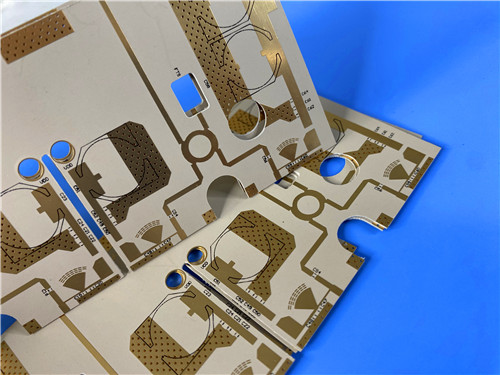
Let’s examine a representative board that our group supplies: a 78 mm×65 mmTF600high frequencyPCB, finished thickness 0.7 mm, ENIG surface finish, no solder mask, no silkscreen on the bottom, and only a black top silkscreen for component designation. This board reflects a common reality in high-frequency prototyping and small-to-medium production runs—engineers want clean RF surfaces, minimal parasitics, and a straightforward via design.
The stackup is deliberately simple: two copper layers, each 35 µm (1 oz), separated by a 0.635 mm (25 mil) TF600 core. Adding the copper and the 20 µm via plating in holes yields a finished board thickness right at 0.7 mm. That thickness is not random. At 25 mils, with a DK of 6.0, a 50-ohm microstrip line width sits at approximately 0.95 mm on a solid ground plane—wide enough to keep tolerances easily manufacturable yet narrow enough for reasonable circuit density. For designers accustomed to fighting etch-tolerance effects on thin, low-DK laminates, this is a welcome relief.
The minimum trace/space of 5/6 mils (0.127 mm / 0.152 mm) indicates moderate lithography requirements, fully compatible with standard laser direct imaging and etch processes. The minimum hole size is 0.35 mm, with through vias only—no blind or buried structures. This deliberate conservatism reduces manufacturing risk and cost while maintaining signal integrity. All vias are through-holes, and on designated IC pads, copper filling is applied.Copper-filled vias under ground paddles of QFN or BGA devices not only improve thermal conduction but also minimize inductance, which is essential when connecting a power amplifier’s ground slug directly to the backside ground plane. The absence of solder mask on both top and bottom layers eliminates any chance of mask-related parasitic capacitance or moisture entrapment. Maskless RF boards require disciplined layout and careful handling but pay dividends in repeatability at frequencies where every femtofarad counts.
The surface finish is ENIG (electroless nickel immersion gold). For RF boards, ENIG’s flatness is more than a cosmetic attribute—it reduces contact resistance variations in edge-connector transitions and provides a solderable surface that resists oxidation during multiple reflow cycles. The nickel barrier also prevents copper migration into gold, preserving the conductivity of gold wire bonds or spring contacts used in test fixtures. The 100% electrical test before shipment is non-negotiable; with nets numbering only two (often a single contiguous ground and a signal net in simple RF modules) or a few more in a comprehensive transceiver board, testing each net guarantees that no open or short escapes detection.
Why the Spec List Matters in Practice?
TF600’s stable DK across temperature and humidity makes it possible to design narrow-band filters without costly post-tuning. Satellite communication payloads, which must maintain absolute bandwidth and center frequency over -40°C to +85°C operating range, benefit from the material’s low thermal coefficient of dielectric constant (not explicitly listed but implied by consistent ceramic filler). For test and measurement equipment like vector network analyzer front-end PCBs, the repeatability of impedance from batch to batch reduces calibration burden and improves instrument reliability.
Applications Reflecting the Material’s Strengths
The attached data sheet highlights applications: microwave/RF transceivers, massive MIMO antennas, automotive ADAS radar, satellite communications, high-power RF amplifiers, and test equipment. These are not aspirational suggestions; they directly follow from the electrical and mechanical characteristics.
Consider a 5G millimeter-wave small cell base station operating at 28 GHz with a 64-element array. Each antenna element’s feed network requires phase-matched traces on a consistent dielectric. The DK of 6.0±0.15 reduces time-delay variation across the array, helping beamforming accuracy. The low Df of 0.0025 ensures that power reaching each element suffers minimal dielectric loss. At the same time, the substrate must survive repeated thermal cycles from outdoor deployment and self-heating of power amplifiers. The UL 94-V0 rating and high CAF resistance keep the board safe and reliable over its design life.
In automotive radar, the 76–81 GHz band demands even tighter tolerance. A DK variation of only 0.15 at 10 GHz, which typically extrapolates to only slightly higher variation at 79 GHz, means that the antenna beam pattern does not skew unpredictably. The 0.06% moisture absorption guarantees that condensation after temperature cycling does not detune the radar module’s mixer and VCO circuits. Moreover, the board’s ability to withstand multiple lead-free reflow passes facilitates two-sided assembly with heavy components.
Satellite payloads demand the ultimate in low-outgassing and radiation tolerance. While TF600’s data sheet does not explicitly list NASA outgassing specs, the modified PTFE system with ceramic filler inherently contains low volatile condensable materials compared to standard epoxy systems, making it a candidate for LEO platforms.
Balancing Performance and Fabrication
What makes TF600 high frequency PCB a practical choice for procurement and design groups is its compatibility with FR-4-type processing. Many high-frequency laminates require sodium naphthalene etchants for via preparation or suffer dimensional instability during lamination. TF600 supports standard drilling, electroless copper plating, and lamination cycles, keeping per-board costs manageable for prototypes and mid-volume runs. For a 2-layer rigid board with 25 mil thickness, the lead time and yield are comparable to a well-characterized RF laminate, not an exotic aerospace ceramic. Our customers often move from a prototype on Rogers RO4835 or Taconic RF-35 straight into a TF600 solution when they need a higher DK and better Z-axis CTE match.
Conclusion
A TF600 PCB is not simply another high-frequency board; it is a calibrated solution for designs that demand a stable DK around 6.0, ultra-low loss, and thermal resilience that aligns with lead-free assembly realities. The 25 mil 2-layer ENIG configuration described here—maskless, copper-filled vias, tight tolerances—embodies a practical implementation that preserves microwave performance from DC to tens of gigahertz without overcomplicating the supply chain. When your next RF front-end, radar sensor, or 5G antenna demands low insertion loss and high repeatability, a TF600-based board offers an engineering path that merges top-tier electrical performance with conventional PCB manufacturing wisdom. As a supplier, we keep the material in stock and the process validated, ready to convert Gerber RS-274-X data into tested, reliable hardware that reaches designers worldwide under IPC Class 2 standards.
Categories
New Blog
Tags
 6-11C Shidai Jingyuan, Fuyong, Baoan, Shenzhen, Guangdong, China 518103


For inquiries about our products or pricelist, please leave to us and we will be in touch within 24 hours.
© Copyright: 2026 Shenzhen Bicheng Electronics Technology Co., Ltd.. All Rights Reserved.

IPv6 network supported


