
 Call Us Now !
Tel : +86 755 27374946
Call Us Now !
Tel : +86 755 27374946
 Order Online Now !
Email : info@bichengpcb.com
Order Online Now !
Email : info@bichengpcb.com
Why Choose ENEPIG Finish Over Other Surface Finishes for a Double-Layer Rogers PCB?
Why Choose ENEPIG Finish Over Other Surface Finishes for a Double-Layer Rogers PCB?
ENEPIG (Electroless Nickel Electroless Palladium Immersion Gold) is increasingly specified for high-performance PCBs, especially those combining RF materials like Rogers RO4003C with mixed-technology assemblies. In the double-layer board described earlier—featuring a 0.5mm RO4003C LoPro core, 1 oz copper, no bottom solder mask, and 100% electrical testing—the choice of ENEPIG was driven by several technical factors that distinguish it from other common surface finishes.
1. Wire Bondability and Mixed-Assembly Compatibility
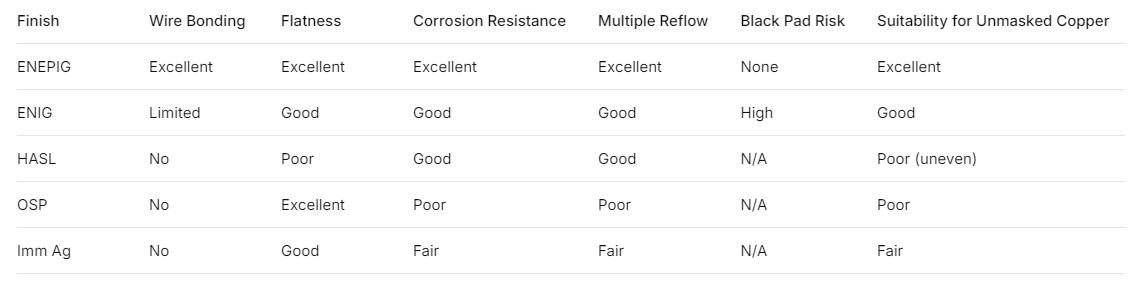
One of the most critical advantages of ENEPIG is its ability to support both wire bonding and soldering on the same surface. The board uses 75 through-hole pads and 27 top‑side SMT pads, indicating a mix of soldered components and possibly direct die‑attach or wire‑bonded devices.
ENIG (Electroless Nickel Immersion Gold) can support wire bonding only with very tight process control, and often suffers from“black pad”issues that compromise bond strength.
ENEPIG adds a palladium layer between nickel and gold. Palladium acts as a diffusion barrier, preventing galvanic corrosion and allowing consistent wire bonding (both gold and aluminum) alongside reliable soldering.
For a double-layer Rogers board where space is tight and component density is moderate (56 components, 102 pads), having a single finish that accommodates both interconnection methods simplifies assembly and reduces cost.
2. Superior Corrosion Resistance and Shelf Life
The board has no solder mask on the bottom side, leaving the bottom copper exposed except for the ENEPIG finish. Without solder mask, the finish becomes the primary barrier against oxidation and environmental degradation.
HASL (Hot Air Solder Leveling) leaves a non‑uniform, thick solder layer that is unsuitable for fine‑pitch components and can introduce surface roughness—problematic for high‑frequency signal integrity.
OSP (Organic Solderability Preservative) is a thin organic coating that offers minimal corrosion protection and degrades quickly with multiple thermal cycles or prolonged storage.
Immersion silver or tin are prone to tarnishing and have limited shelf life.
ENEPIG provides a robust, long‑lasting surface that withstands extended storage and multiple reflow cycles without degradation. For a worldwide‑availability product, this ensures consistent solderability regardless of supply chain timelines.
3. Flatness and Uniformity for High‑Frequency Performance
The board’shigh frequency material (RO4003C LoPro) and the presence of controlled‑impedance traces (minimum 4/6 mil trace/space) demand a surface finish that does not introduce impedance variation or signal reflection.
HASL produces uneven topography that can alter trace impedance and increase insertion loss at microwave frequencies.
ENEPIG deposits a thin, extremely flat, and uniform metal stack (typically 3–6 µin gold, 4–8 µin palladium, and 120–240 µin nickel). The planar surface preserves the controlled impedance designed into the 4 mil traces and 0.4 mm vias.
Because the bottom side is unsoldermasked, any non‑uniformity there would be directly exposed to the environment; ENEPIG’s flatness eliminates this risk.
4. Prevention of“Black Pad”and Intermetallic Reliability
ENIG has a well‑known failure mechanism called“black pad”—excessive corrosion of the nickel layer during the immersion gold process, leading to brittle solder joints. This is particularly problematic for boards that require high reliability (IPC‑Class‑2 in this case) and 100% electrical testing.
ENEPIG’s palladium layer completely separates the nickel from the gold bath, eliminating black pad. Additionally, the palladium layer controls the formation of intermetallic compounds (IMCs) during soldering, resulting in more robust solder joints for both SMT and through‑hole components. Given that the board has 75 through‑hole pads and relies on plated through‑holes with 20 µm copper, long‑term joint integrity is paramount.
5. Compatibility with Lead‑Free Assembly and High‑Temperature Processes
The RO4003C LoPro material is designed for lead‑free processing (Tg > 280°C, Td > 425°C). ENEPIG is fully compatible with lead‑free solders and can withstand multiple reflow cycles without degradation.
OSP decomposes under multiple thermal cycles.
Immersion silver can suffer from silver migration and voiding under high‑temperature assembly.
ENEPIG remains stable, ensuring the board meets its intended thermal and reliability targets even when subjected to the high‑temperature profiles required for lead‑free assembly.
6. No Bottom Solder Mask: The Unique Case
The decision to omit solder mask on the bottom layer is unusual and demands a finish that provides both electrical insulation (through its inert metal layers) and protection against shorts or corrosion. ENEPIG meets this need: the gold layer is highly corrosion‑resistant, the palladium layer prevents nickel oxidation, and the overall thickness is sufficient to withstand handling without exposing base copper. In contrast, OSP or immersion silver would leave the bottom copper vulnerable to oxidation during assembly and field use, potentially causing reliability issues in humid environments.
Comparison Summary
Conclusion
For this double-layer Rogers RO4003C LoPro PCB—with its 0.5 mm thickness, fine trace geometry, mixed through‑hole and SMT assembly, absence of bottom solder mask, and IPC‑Class‑2 reliability requirement—ENEPIG was the optimal surface finish. It uniquely combines wire‑bonding capability, superior corrosion protection, flatness for high‑frequency performance, and robust lead‑free assembly support. While ENEPIG carries a slightly higher upfront cost than ENIG or OSP, the investment is justified by the extended shelf life, improved assembly yields, and long‑term reliability essential for worldwide deployment in applications such as base station antennas, high‑speed backplanes, and RF identification systems.
Categories
New Blog
Tags
 6-11C Shidai Jingyuan, Fuyong, Baoan, Shenzhen, Guangdong, China 518103


For inquiries about our products or pricelist, please leave to us and we will be in touch within 24 hours.
© Copyright: 2026 Shenzhen Bicheng Electronics Technology Co., Ltd.. All Rights Reserved.

IPv6 network supported


