
 Call Us Now !
Tel : +86 755 27374946
Call Us Now !
Tel : +86 755 27374946
 Order Online Now !
Email : info@bichengpcb.com
Order Online Now !
Email : info@bichengpcb.com
Is F4BTM298 a Practical Premium Laminate Alternative?
Is F4BTM298 a Practical Premium Laminate Alternative?
Quick Answer
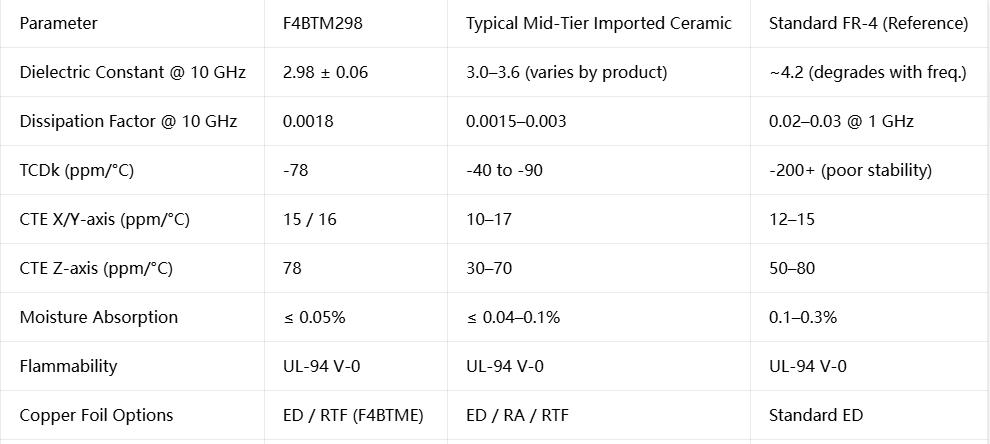
Yes—Wangling F4BTM298 is a practical alternative to imported premium RF laminates for many high-frequency designs, particularly those targeting 10 GHz and below where a Dk of 2.98 fits the application. Manufactured by Wangling using a PTFE nano-ceramic composite with fiberglass reinforcement, it delivers Dk 2.98±0.06 and Df 0.0018 at 10 GHz, matching the loss performance tier of mid-range imported hydrocarbon ceramics while offering shorter lead times and better pricing for Asia-based production. It is not a drop-in replacement for every premium material—Dk values differ, and the highest-frequency PIM-critical designs still benefit from RTF copper variants—but for base station feed networks, power dividers, couplers, and L-to-Ku band passive circuits, F4BTM298 consistently meets specifications and has been proven in volume production at Bicheng.
Key Takeaways
- Comparable loss performance: Df of 0.0018 at 10 GHz places F4BTM298 in the same low-loss category as established premium hydrocarbon ceramic laminates.
- Dk of 2.98 fills a niche between 3.55-class materials (such as RO4003C) and lower-Dk pure PTFE boards, suiting designs originally characterized around the 3.0 Dk range.
- Shorter domestic supply chains reduce lead times from 8–12 weeks for imported specialty materials to standard PCB production cycles for Wangling-based boards.
- Two copper options—ED foil for cost-sensitive designs and RTF foil (F4BTME298) for PIM-critical applications—cover most premium-laminate use cases.
- IPC-Class-2 manufacturability and UL-94 V-0 ensure the material scales from prototype to volume production without qualification surprises.
---
The Case for Domestic Alternatives
F4BTM298 Performance Profile
Head-to-Head with Imported Premium Laminates
Supply Chain and Manufacturing Practicality
Design Migration Considerations
---
Real-World Migration Case
A Bicheng customer manufacturing L-band base station feed networks provides a concrete example. The customer's original design used an imported PTFE-based laminate and was fully qualified. When a supply disruption extended lead times to 11 weeks, the customer needed a drop-in alternative to keep production running.
Because the original material had a Dk close to 3.0, the impedance change was minimal—less than 1 ohm on the 50-ohm lines—and well within the system's return loss margin. Bicheng built first-article boards on F4BTM298 and ran full S-parameter characterization. Across the 0.8–2.2 GHz operating band, insertion loss matched the original material within 0.05 dB, return loss exceeded -22 dB on all ports, and phase balance between outputs stayed under 1.5 degrees, compared to a 3-degree specification.
The customer qualified F4BTM298 as a second source within two weeks and has since shifted a significant portion of production volume to the material. The primary benefit was not a dramatic performance improvement—the material performs comparably—but supply chain resilience and a meaningful reduction in per-board material cost, with no compromise in electrical specifications.
---
Comparative Specification Reference
Frequently Asked Questions
1) Q: Can F4BTM298 directly replace Rogers RO4003C without redesign?
Not without layout adjustment, because the Dk values differ—2.98 versus 3.55. Controlled-impedance traces must be resized to maintain the same target impedance, which means updating the Gerber files. However, the overall design topology, component placement, and system architecture remain valid. For new designs starting from scratch, or for projects where a layout revision is already planned, migrating to F4BTM298 is straightforward and can yield meaningful cost and lead-time savings.
2) Q: Is F4BTM298 suitable for millimeter-wave designs above 20 GHz?
F4BTM298 is primarily characterized at 10 GHz and performs reliably well into the Ku band (12–18 GHz). Above 20 GHz, conductor losses begin to dominate, and the surface roughness of standard ED copper becomes a limiting factor. For Ka-band and higher millimeter-wave applications, we recommend evaluating the F4BTME298 variant with RTF copper foil, which has a smoother surface profile that reduces skin-effect loss. The very highest mmWave designs may still require ultra-smooth rolled copper laminates, but F4BTME298 covers a substantial middle ground.
3) Q: How does the cost compare to imported premium laminates?
F4BTM298 typically offers 25–40% raw material cost savings compared to equivalent imported hydrocarbon ceramic laminates, with the exact delta depending on thickness, copper weight, and volume. The savings are amplified when factoring in shorter lead times, no import duties or international freight for Asia-based production, and reduced inventory carrying costs. For volume production runs, the accumulated savings can be substantial enough to fund the initial design migration and qualification effort.
4) Q: What quality certifications does F4BTM298 carry?
F4BTM298 laminates carry UL-94 V-0 flammability certification and are manufactured under Wangling's ISO-certified production processes. PCBs built on F4BTM298 at Bicheng are fabricated to IPC-Class-2 acceptance criteria as standard, with IPC-Class-3 available on request. Every production lot undergoes standard material inspection, and every finished PCB receives 100% electrical testing before shipment. For customers requiring formal material qualification, Bicheng can provide test coupons and supporting documentation.
5) Q: Are multi-layer boards possible with F4BTM298?
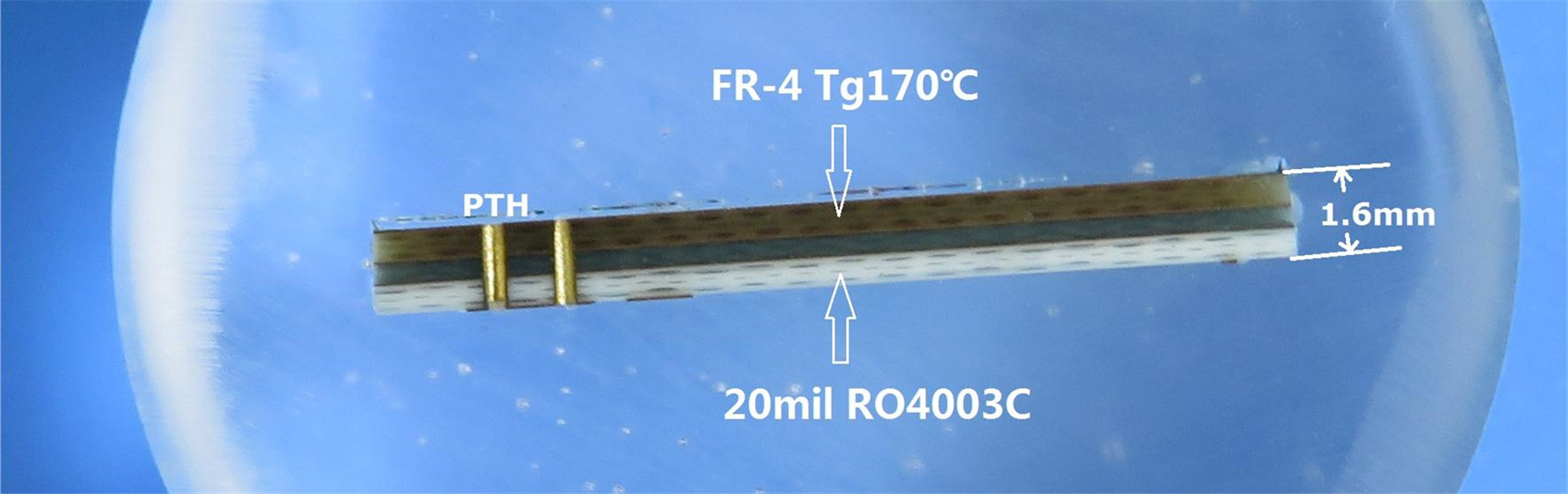
Yes. While the reference design discussed here is a 2-layer 0.3 mm board, F4BTM298 is available in multiple core thicknesses and can be used in multi-layer stackups with compatible prepreg. Hybrid stackups combining F4BTM298 in RF sections with FR-4 or low-loss epoxy in digital sections are also common and cost-effective for mixed-signal designs. Bicheng supports 4-layer, 6-layer, and custom multi-layer configurations on F4BTM298, with controlled impedance across all signal layers.
---
Conclusion
F4BTM298 high frequency PCBs aresupplied by Bicheng, an authorized OEM partner of Wangling High-Frequency Materials, and are available for worldwide shipment. All boards receive 100% electrical testing and meet IPC-Class-2 acceptance standards. For second-source evaluation or design migration support, contact Bicheng's technical team with your Gerber files and material requirements.
Categories
New Blog
Tags
 6-11C Shidai Jingyuan, Fuyong, Baoan, Shenzhen, Guangdong, China 518103


For inquiries about our products or pricelist, please leave to us and we will be in touch within 24 hours.
© Copyright: 2026 Shenzhen Bicheng Electronics Technology Co., Ltd.. All Rights Reserved.

IPv6 network supported


