
 Call Us Now !
Tel : +86 755 27374946
Call Us Now !
Tel : +86 755 27374946
 Order Online Now !
Email : info@bichengpcb.com
Order Online Now !
Email : info@bichengpcb.com
How Does Hybrid Stackup of AD250C and FR-4 Balance RF Performance and Structural Integrity?
How Does Hybrid Stackup of AD250C and FR-4 Balance RF Performance and Structural Integrity?
In the realm of high-frequency printed circuit board design, engineers are often forced to make compromises. On one hand, RF performance demands low-loss materials with stable dielectric constants. On the other, mechanical reliability and cost-effectiveness call for conventional materials like FR-4. Striking the right balance is rarely straightforward.
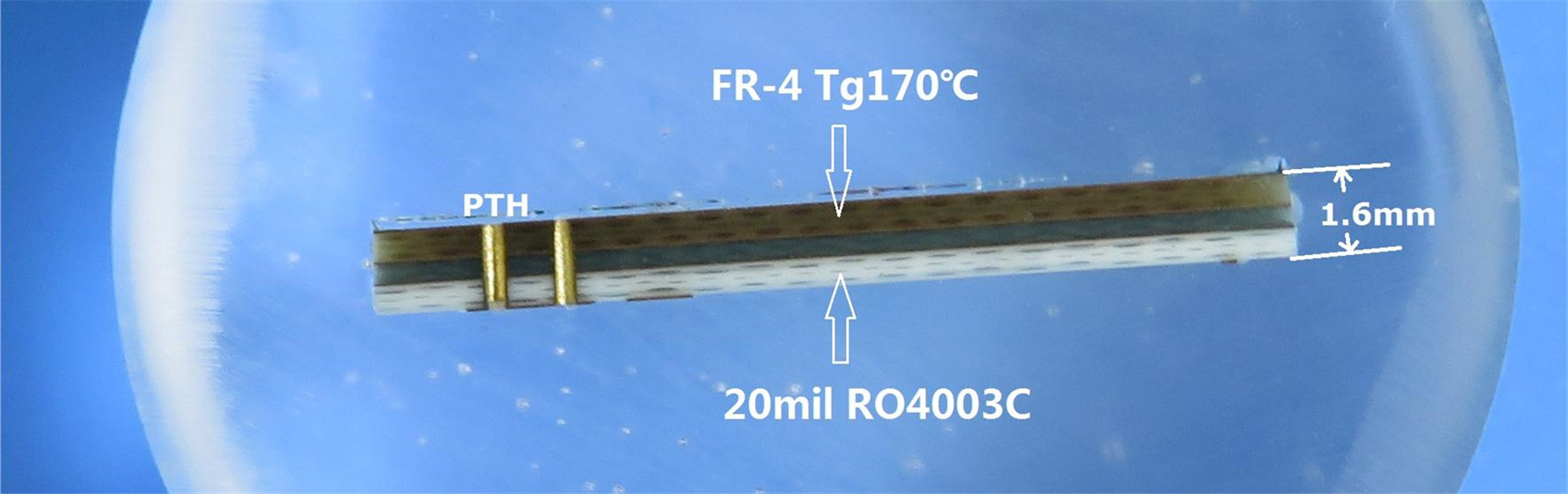
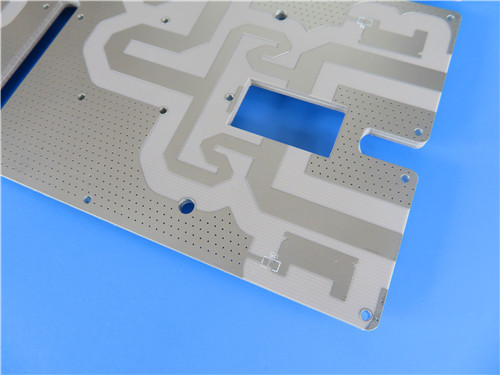
One increasingly popular solution is the hybrid PCB stackup, which combines specialized RF laminates with standard FR-4 materials within a single multilayer board. A prime example of this approach is the 4-layer PCB that pairs Rogers AD250C with TG170 FR-4, featuring a 60mil (1.524mm) AD250C core and a finished thickness of 1.8mm. This design effectively addresses the competing demands of signal integrity, thermal management, and structural stability.
But how exactly does this hybrid construction achieve such a balance? Let’s break it down from a materials engineering and manufacturing perspective.
The Core Challenge: RF Materials vs. Structural Materials
Pure PTFE-based RF laminates, such as Rogers high-frequency materials, offer exceptional electrical properties—low dissipation factor, controlled dielectric constant, and excellent passive intermodulation (PIM) performance. However, they come with inherent challenges: they are mechanically soft, exhibit relatively high coefficients of thermal expansion (CTE) in the Z-axis, and can be difficult to process in multilayer configurations, especially when thick boards or complex registration are required.
Conventional FR-4, particularly with a high glass transition temperature (TG170), provides mechanical rigidity, dimensional stability, and cost efficiency. But its dissipation factor (typically above 0.01 at high frequencies) makes it unsuitable for critical RF signal layers where minimal loss is required.
A hybrid stackup resolves this conflict by assigning each material to the layers where it performs best. The RF signal layers are built on the low-loss material, while the remaining layers—typically power distribution, secondary signals, and mechanical support—rely on FR-4.
Deconstructing the 4-Layer Hybrid Stackup
The stackup in question is structured as follows:
|
Layer |
Material |
Thickness |
|
Layer 1 (Top Signal) |
1 oz Copper |
35 μm |
|
Dielectric |
AD250C Substrate |
1.524 mm (60 mil) |
|
Layer 2 (Ground) |
1 oz Copper |
35 μm |
|
Prepreg |
FR-4 |
0.2 mm |
|
Layer 3 (Power/Signal) |
1 oz Copper |
35 μm |
|
Core |
TG170 FR-4 |
0.102 mm (4 mil) |
|
Layer 4 (Bottom Signal) |
1 oz Copper |
35 μm |
This arrangement is not arbitrary. Each layer serves a distinct purpose.
RF Performance: The Role of AD250C
The top two layers form the RF-critical section of the board. The 60mil AD250C substrate sits between the top signal layer (Layer 1) and the ground plane (Layer 2). AD250C is a glass-reinforced, PTFE-based antenna laminate designed specifically for wireless applications. Its key electrical properties include:
The relatively thick 60mil dielectric provides several advantages. For a given characteristic impedance (e.g., 50Ω), a thicker dielectric allows for wider trace widths. Wider traces reduce conductor loss, which is particularly beneficial at higher frequencies where skin effect becomes dominant. Additionally, the thick core provides physical separation between the RF signal layer and the lower layers, minimizing coupling into the FR-4 section and preserving signal purity.
Because AD250C is woven glass-reinforced, it offers better dimensional stability than unfilled PTFE materials. This reinforcement improves registration during lamination—a critical factor when bonding to an FR-4 substructure.
Structural Integrity: The Role of TG170 FR-4
Below the ground plane, the stackup transitions to FR-4 materials. A thin FR-4 prepreg (0.2mm) bonds the AD250C core to the TG170 FR-4 core (0.102mm) . The TG170 rating indicates a glass transition temperature of approximately 170°C, which ensures the material maintains its mechanical properties during lead-free assembly processes such as reflow soldering.
While the FR-4 section does not carry the primary RF signals, it fulfills several critical functions:
Mechanical Rigidity: The combination of the 60mil AD250C core and the FR-4 layers yields a total finished board thickness of 1.8mm. This thickness provides the structural strength required for connector mounting, handling during assembly, and long-term reliability in field environments such as cellular base stations or automotive telematics systems.
Thermal Management: FR-4, while not a high-thermal-conductivity material, offers predictable thermal behavior. The TG170 core helps the board withstand the thermal cycling encountered in outdoor antenna enclosures without excessive warpage or delamination.
Cost Efficiency: By limiting the use of Rogers material to only the layers that truly require low-loss performance, the hybrid stackup significantly reduces material cost compared to a full-board Rogers construction, while still achieving the necessary RF specifications.
Manufacturing Considerations: Making the Hybrid Work
Hybrid stackups introduce complexity in fabrication. Laminating PTFE-based materials with FR-4 requires careful surface preparation. AD250C, with its glass-reinforced structure, is more amenable to multilayer processing than soft PTFE materials, but proper plasma treatment or chemical etching is typically required to ensure adequate adhesion between the AD250C core and the FR-4 prepreg.
Another consideration is thermal expansion mismatch. AD250C has a Z-axis CTE of 196 ppm/°C, while FR-4 typically ranges from 50 to 70 ppm/°C. In a 4-layer construction with a thick AD250C core, the stress is managed by maintaining a balanced stackup and ensuring that plated through-holes (PTHs) are properly designed. In this design, the via plating thickness is specified at 20μm, exceeding IPC Class 2 minimum requirements to provide additional robustness against thermal cycling stresses.
The absence of solder mask on the top and bottom layers—deliberate in this RF design—further simplifies fabrication by eliminating a variable that could affect impedance control and PIM performance. It also reduces the risk of trapped contaminants or uneven dielectric coverage that could degrade high-frequency performance.
Real-World Applications: Where This Balance Matters
The engineering choices embodied in this hybrid stackup are not academic; they directly serve practical applications. This 4-layer hybrid PCB construction is well-suited for:
Conclusion: A Purpose-Built Compromise
No single material excels in every parameter. The AD250C TG170 FR-4 hybrid PCB is a pragmatic engineering solution that acknowledges this reality. By dedicating the RF signal layer and its immediate ground return to a high-performance antenna laminate, while relying on FR-4 for mechanical support and thermal stability, this 4-layer construction achieves a balance that pure-material designs often cannot.
For engineers designing wireless infrastructure or automotive antenna systems, this approach delivers the electrical performance required for modern frequency bands—up to and beyond 10 GHz—without sacrificing the structural integrity and cost predictability necessary for volume production. It is a design strategy that reflects not just material selection, but a thoughtful integration of materials science, fabrication capability, and application-specific requirements.
Categories
New Blog
Tags
 6-11C Shidai Jingyuan, Fuyong, Baoan, Shenzhen, Guangdong, China 518103


For inquiries about our products or pricelist, please leave to us and we will be in touch within 24 hours.
© Copyright: 2026 Shenzhen Bicheng Electronics Technology Co., Ltd.. All Rights Reserved.

IPv6 network supported


