
 Call Us Now !
Tel : +86 755 27374946
Call Us Now !
Tel : +86 755 27374946
 Order Online Now !
Email : info@bichengpcb.com
Order Online Now !
Email : info@bichengpcb.com
Why Choose Rogers CuClad 217 for High-Frequency PCBs?
Why Choose Rogers CuClad 217 for High-Frequency PCBs?
A Look at Dk, Df, and Isotropy
Selecting the right laminate is a primary decision in high-frequency PCB development. Standard materials like FR-4 are not suitable when signal integrity is required above 500 MHz. For radar systems, aerospace communications, or microwave components, the substrate material directly affects circuit performance.
Rogers CuClad 217 is a material used in these applications. This article explains its key properties: Dielectric Constant (Dk), Dissipation Factor (Df), and mechanical isotropy.
1. Dielectric Constant (Dk)
The dielectric constant measures how a material affects the electric field between conductors. It determines signal velocity and transmission line dimensions.
Signal Speed
Trace Geometry
Dk Stability
2. Dissipation Factor (Df)
Dissipation factor, or loss tangent, quantifies energy loss as heat when a signal passes through the dielectric.
Signal Loss
A higher Df material absorbs RF energy and converts it to heat. This results in:
CuClad 217 has a Df of 0.0009 at 10 GHz. This is a low value within PTFE-based laminates.
Practical Effect
For a low noise amplifier (LNA), a low Df means the input signal reaches the amplifier with minimal degradation. For a filter, it results in sharper band-pass characteristics and lower in-band loss.
3. In-Plane Isotropy
Isotropy refers to uniform properties in all directions. This is relevant for phase-sensitive circuits.
The Issue with Standard Materials
Standard woven fiberglass laminates have warp and fill directions. Glass fibers run predominantly in these orientations. When a trace runs parallel to the warp versus the fill, the effective Dk can vary slightly. This can affect phase response.
Cross-Plied Construction
CuClad 217 substrate uses cross-plied construction. Coated fiberglass plies are placed at alternating 90-degree orientations. This creates a structure that is mechanically and electrically uniform in the X-Y plane.
Result
Whether a microstrip line runs horizontally, vertically, or diagonally on the board, the dielectric constant it experiences is consistent. This helps prevent phase skew in distributed circuits such as couplers or patch antenna arrays.
Comparison with Other Materials
|
Material |
Dk (approx.) |
Df (approx.) |
X-Y Uniformity |
|
Rogers CuClad 217 |
2.17 |
0.0009 |
Yes (cross-plied) |
|
Standard PTFE/Woven Glass |
2.2–2.5 |
0.0015–0.002 |
No |
|
Ceramic-Filled PTFE |
3.0–10.0 |
0.0010–0.0013 |
Yes |
Typical Applications
These properties make CuClad 217 high frequency PCB suitable for specific applications:
Fabrication Considerations
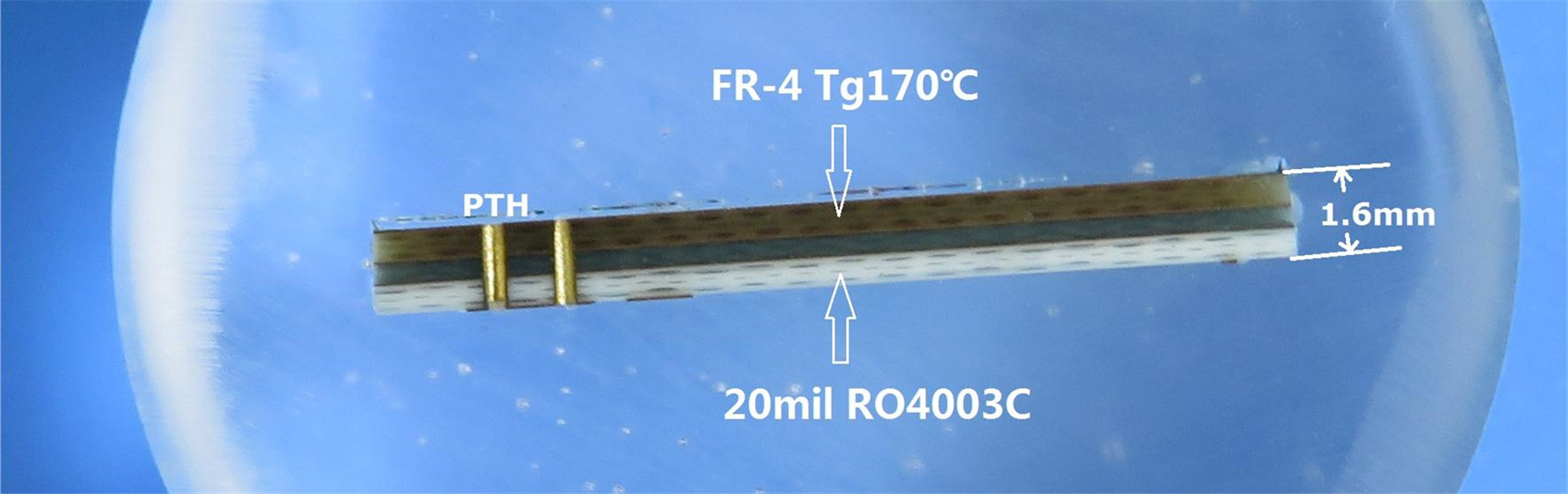
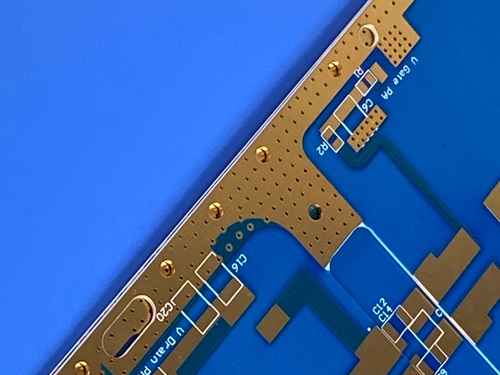
PTFE materials require specific handling during PCB fabrication. A typical 2-layer CuClad 217 board includes:
Layer Count: 2 layers
Core Thickness: 0.508 mm (20 mil)
Copper Weight: 1 oz finished
Surface Finish: Immersion gold (ENIG) to protect copper and provide a flat surface for component assembly
Minimum Hole Size: 0.2 mm
Minimum Trace/Space: 4/5 mils
Quality Standard: IPC-Class 2
Testing: 100% electrical test prior to shipment
Summary
Rogers CuClad 217 PCB offers:
These specifications make it a practical choice for radar, countermeasure, and satellite communication systems where material performance directly affects circuit function.
Categories
New Blog
Tags
 6-11C Shidai Jingyuan, Fuyong, Baoan, Shenzhen, Guangdong, China 518103


For inquiries about our products or pricelist, please leave to us and we will be in touch within 24 hours.
© Copyright: 2026 Shenzhen Bicheng Electronics Technology Co., Ltd.. All Rights Reserved.

IPv6 network supported


