
 Call Us Now !
Tel : +86 755 27374946
Call Us Now !
Tel : +86 755 27374946
 Order Online Now !
Email : info@bichengpcb.com
Order Online Now !
Email : info@bichengpcb.com
How Does Nickel-Free EPIG Improve PIM Performance in Base Station Antennas?
How Does Nickel-Free EPIG Improve PIM Performance in Base Station Antennas?
Passive Intermodulation (PIM) is one of the most critical performance killers in modern cellular infrastructure. In a base station antenna system, PIM appears as unwanted interference generated by passive components—connectors, cables, and the printed circuit board itself—when two or more high-power transmit signals mix. Even a small amount of PIM can desensitize the receiver, reduce data throughput, and cause dropped calls.
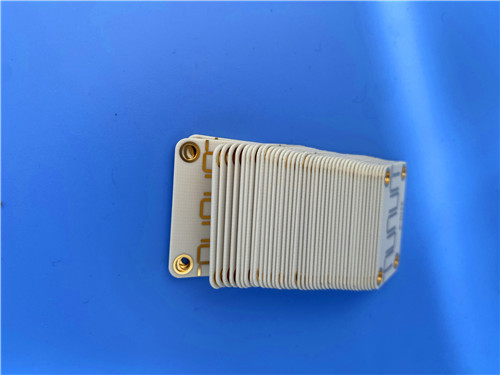
For years, the industry has focused on materials and finishes that minimize PIM. One of the most effective advances has been the adoption of nickel-free EPIG (Electroless Palladium Immersion Gold) as a surface finish. To understand why, let's examine a real-world example: a2-layer 40mil AD300D PCB designed specifically for base station antenna applications.
The PIM Problem in Traditional Surface Finishes
Most circuit boards intended for wireless infrastructure use ENIG (Electroless Nickel Immersion Gold). ENIG consists of a layer of nickel (typically 3–6 µm) covered by a thin layer of immersion gold. The nickel acts as a diffusion barrier and provides mechanical strength, but it also introduces a ferromagnetic material into the signal path.
Nickel exhibits magnetostrictive behavior and, in the presence of high RF currents, can generate nonlinearities. These nonlinearities are a primary source of PIM. Even when the gold layer appears intact, the underlying nickel can cause intermodulation products that fall directly into the uplink band of a base station receiver. For example, in a 1900 MHz PCS system, two downlink carriers (1930 MHz and 1945 MHz) can mix to produce a 1915 MHz product that interferes with the uplink.
EPIG: Eliminating the Nickel Layer
EPIG (Electroless Palladium Immersion Gold) replaces the nickel layer with a thin palladium layer. In its nickel-free variant, the stack becomes:
Copper base (the PCB trace)
Electroless palladium (≈0.1–0.3 µm)
Immersion gold (≈0.05–0.1 µm)
Palladium is a noble metal with non-ferromagnetic properties. By removing nickel entirely, the surface finish no longer contributes to magnetostriction or nonlinear magnetic hysteresis. The result is a dramatic reduction in PIM generation at the trace-to-solder interface, especially under high-power conditions.
In the AD300D-based PCB mentioned above, the nickel-free EPIG finish is applied over 1-oz copper traces (35 µm) with a 4/6 mil trace/space geometry. Because the board carries only two nets and features 29 through-hole pads, the EPIG finish covers both the pads and the plated through-holes uniformly, ensuring that every solder joint—whether for connectors or power amplifiers—benefits from the low-PIM interface.
Synergy with AD300D Laminate
A low-PIM surface finish is only half the equation. The dielectric material underneath plays an equally important role. AD300D is a ceramic-filled, glass-reinforced PTFE laminate engineered specifically for wireless antenna applications. Its key attributes include:
Very low PIM rating:–159 dBc at 30 mil thickness (1900 MHz). When combined with nickel-free EPIG, the total PIM contribution from the PCB is minimized to levels that meet the most stringent base station requirements.
Low loss tangent (Df): 0.0021 at 10 GHz, reducing passive intermodulation that can arise from dielectric nonlinearity.
Controlled dielectric constant (Dk 2.94±0.05): Ensures that impedance matching is repeatable, preventing reflections that could exacerbate PIM.
The 40-mil (1.016 mm) core thickness of AD300D in this 2-layer stackup provides a consistent RF ground plane distance, allowing for well-controlled 50-ohm traces. With no solder mask on either side, the board avoids additional dielectric interfaces that could introduce further PIM sources.
Why Base Station Antennas Benefit Most
Base station antennas are exposed to high transmit power—often 20 to 40 watts per carrier—and must simultaneously receive extremely weak uplink signals. The PIM requirement for such systems is typically≤ –150 dBc. Meeting this specification demands careful material selection at every level.
The AD300D PCB with nickel-free EPIG is a direct response to this need. It is designed for:
Multi-band array antennas where multiple carriers can mix unpredictably.
Remote radio head (RRH) interfaces where the PCB connects high-power amplifiers to radiating elements.
Automated assembly because EPIG provides a flat, solderable surface with excellent wire-bondability, yet does not introduce the magnetic artifacts of nickel.
Furthermore, the absence of solder mask and silkscreen on this particular board eliminates two additional layers of material that can trap flux residues and moisture—both of which can contribute to PIM over time.
Measurable Impact
When a base station antenna manufacturer switches from a standard ENIG finish to nickel-free EPIG on the same AD300D laminate, typical PIM improvements range from 10 to 20 dB at the board level. This improvement often reduces the need for costly external PIM filters or re-working of field installations.
Because the AD300D Rogers material also exhibits excellent dimensional stability (CTE 23–24 ppm/°C in X/Y), the combination ensures that the finish and the dielectric remain mechanically stable over temperature cycles, preserving the low-PIM characteristic throughout the product's lifetime.
Conclusion
For base station antennas, every component in the RF path must be scrutinized for PIM. The choice of PCB surface finish is no longer a secondary decision. Nickel-free EPIG addresses the root cause of ferromagnetic nonlinearities by eliminating nickel entirely, while providing the solderability and corrosion resistance required for outdoor infrastructure.
When paired with a low-loss, low-PIM laminate like AD300D and fabricated with a clean, mask-less design, the result is a PCB that not only meets but exceeds the demanding PIM specifications of 4G, 5G, and next-generation wireless networks. For engineers designing base station antennas, telematics systems, or satellite radio equipment, the AD300D 2-layer 40mil PCB with nickel-free EPIG offers a proven, cost-effective path to superior intermodulation performance.
Categories
New Blog
Tags
 6-11C Shidai Jingyuan, Fuyong, Baoan, Shenzhen, Guangdong, China 518103


For inquiries about our products or pricelist, please leave to us and we will be in touch within 24 hours.
© Copyright: 2026 Shenzhen Bicheng Electronics Technology Co., Ltd.. All Rights Reserved.

IPv6 network supported


