What Makes DiClad 870’s Low Dk and DF Critical for Radar and Antenna Designs?
In high-frequency printed circuit boards, the choice of dielectric material is not merely a matter of mechanical support—it directly governs signal integrity, insertion loss, and phase stability. For radar systems, antenna feed networks, and other RF applications, two material parameters stand out above all: dielectric constant (Dk) and dissipation factor (Df). When these values are kept low and stable, the circuit board becomes an enabler rather than a limitation.
Rogers DiClad 870, a woven fiberglass-reinforced PTFE composite, offers a combination of low Dk and low Df that makes it particularly suited for such applications. In this article, we explore why these properties are critical for radar and antenna designs, using a specific 2-layer PCB configuration built on DiClad 870 with immersion silver finish as a practical reference.
Understanding Dk and Df in RF Circuits
-
The dielectric constant (Dk) of a material determines how much an electromagnetic wave slows down when propagating through it. In practical terms, Dk influences the physical dimensions of transmission lines, the impedance of traces, and the phase of signals. A lower Dk allows wider trace widths for a given impedance, reducing conductor losses. More importantly, a low Dk that remains stable across frequency and temperature ensures predictable phase behavior—a non-negotiable requirement in phased-array antennas and radar beamforming.
-
Dissipation factor (Df), often called loss tangent, quantifies the inherent energy loss in the dielectric as heat. High Df leads to signal attenuation, reducing the efficiency of antennas and degrading the sensitivity of receivers. In radar systems, where every decibel of signal loss translates to reduced range or detection capability, a low Df is essential.
DiClad 870: Engineered for Low Loss and Stability
-
DiClad 870 achieves its low Dk of 2.33 (at both 10 GHz and 1 MHz, 50% RH) by using fewer plies of woven fiberglass and a higher PTFE resin content compared to other laminates in the DiClad laminate series. This composition reduces the polarizing effects of fiberglass, yielding a more consistent electrical environment.
-
The dissipation factor is equally impressive: 0.0013 at 10 GHz and 0.0009 at 1 MHz. At microwave frequencies, such low loss tangents mean that passive circuits like filters, couplers, and feed networks can achieve higher Q factors and lower insertion loss. In antenna applications, this translates to improved radiation efficiency.
-
Equally important is the thermal coefficient of Dk (TcDk):−161 ppm/°C over a−10°C to 140°C range at 10 GHz. This small negative drift means that as temperature rises, the Dk decreases only slightly, causing minimal phase shift. For radar systems that operate in wide temperature ranges—whether on ground-based antennas or airborne platforms—this stability prevents beam steering errors and ensures consistent performance.
The PCB Construction: A Case Study
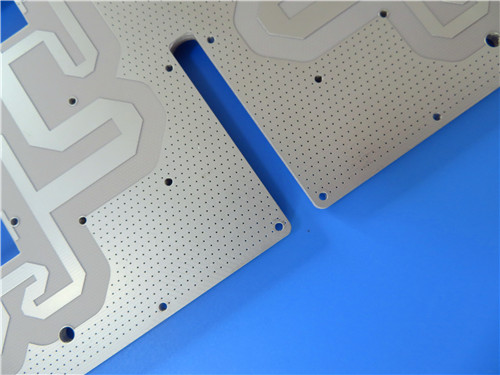
To see these principles in action, consider a specific 2-layer rigid PCB designed for high-frequency applications. The construction details are as follows:
-
Base material: DiClad 870
-
Layer count: 2
-
Board dimensions: 112 mm×68 mm (±0.15 mm)
-
Minimum trace/space: 6/7 mils
-
Minimum hole size: 0.25 mm (no blind vias)
-
Finished board thickness: 0.2 mm
-
Copper weight: 1 oz (35μm) outer layers
-
Via plating thickness: 20μm
-
Surface finish: Immersion silver
-
Solder mask: None on top or bottom
-
Silkscreen: White on top only
-
Electrical test: 100% prior to shipment
The stack-up is straightforward:
-
Copper layer 1: 35μm
-
Dielectric: DiClad 870, 0.127 mm (5 mils)
-
Copper layer 2: 35μm
With a total board thickness of only 0.2 mm, this design is inherently thin, but the choice of DiClad 870 ensures that electrical performance remains uncompromised.
Why Low Dk Enables Better Antenna and Radar Designs
1. Wider traces for lower conductor loss
For a given characteristic impedance (e.g., 50Ω), a lower Dk allows wider trace widths. In this design, with Dk = 2.33, microstrip traces can be significantly wider than on standard FR-4 (Dk≈4.2). Wider traces reduce resistive losses, which is especially beneficial in antenna feed networks where long runs of transmission lines are common.
2. Stable phase in phased arrays
Phased-array antennas rely on precise phase control to steer the beam. Any variation in Dk across the board or with temperature introduces phase errors. DiClad 870’s low TcDk and uniform resin distribution minimize such variations, allowing more predictable beamforming. The 2-layer construction, while simple, benefits from the consistent dielectric environment because there are no additional prepreg layers to introduce variability.
3. Reduced signal attenuation
The low Df directly reduces insertion loss. In radar feed networks, where signals may be split, combined, or routed over distance, every 0.1 dB of saved loss improves system noise figure and range. For antenna elements, lower loss means more power radiated and less heat generated in the substrate.
The Role of Immersion Silver and No Solder Mask
-
In high-frequency designs, the surface finish and solder mask also contribute to loss. Immersion silver provides a flat, highly conductive surface that is well-suited for microstrip and grounded coplanar waveguide structures. Its thickness is minimal, so it does not significantly affect impedance.
-
The absence of solder mask on this Rogers PCB is a deliberate choice. Solder mask, while offering protection, adds a lossy layer with its own Dk and Df. At microwave frequencies, even a thin solder mask can increase insertion loss and cause impedance deviations. By omitting it, the design preserves the pristine low-loss properties of the DiClad 870 and the copper traces.
Practical Applications Benefiting from These Characteristics
The combination of DiClad 870, a thin 2-layer stack-up, and immersion silver finish makes this PCB suitable for a range of radar and antenna applications, including:
-
Radar feed networks–Low loss and stable phase ensure accurate power distribution.
-
Commercial phased-array antennas–Consistent Dk across temperature and frequency enables reliable beam steering.
-
Low-loss base station antennas–Improved efficiency reduces power consumption and cooling requirements.
-
Guidance systems–Predictable signal behavior under environmental stress is critical.
-
Filters, couplers, and LNAs–High Q and low loss tangents improve selectivity and noise figure.
Manufacturing and Quality Assurance
-
PTFE-based materials like DiClad 870 require specialized processing. Hole preparation, copper surface treatment, and registration demand close control. This board is built to IPC-Class-2 standards, which is widely accepted for dedicated-service electronics. Prior to shipment, 100% electrical testing verifies continuity and isolation across both nets.
-
With a simple two-net design, the electrical test is straightforward, but the real performance lies in the high-frequency behavior—something that standard electrical tests do not measure directly. However, the consistent material properties and precise fabrication ensure that the RF performance meets design expectations.
Global Availability
-
As a supplier serving worldwide customers, we maintain the capability to fabricate this PCB configuration with repeatable quality. Whether for prototype evaluation or production volumes, the combination of DiClad 870 and immersion silver is available with full material traceability and technical support.
Conclusion
-
Low dielectric constant and low dissipation factor are not abstract specifications—they are the pillars of high-frequency circuit performance. In radar and antenna designs, these properties directly influence signal loss, phase stability, and overall system efficiency. Rogers DiClad 870 PCB delivers a low Dk of 2.33, a Df as low as 0.0013 at 10 GHz, and a stable TcDk, making it a reliable choice for applications that demand consistent electrical behavior.
-
The 2-layer PCB described here, with its thin profile, immersion silver finish, and absence of solder mask, exemplifies how material selection and construction choices work together to preserve the inherent advantages of DiClad 870 high frequency PCB. For engineers designing next-generation radar and antenna systems, such attention to material and manufacturing detail is not an option—it is a necessity.