
 Call Us Now !
Tel : +86 755 27374946
Call Us Now !
Tel : +86 755 27374946
 Order Online Now !
Email : info@bichengpcb.com
Order Online Now !
Email : info@bichengpcb.com
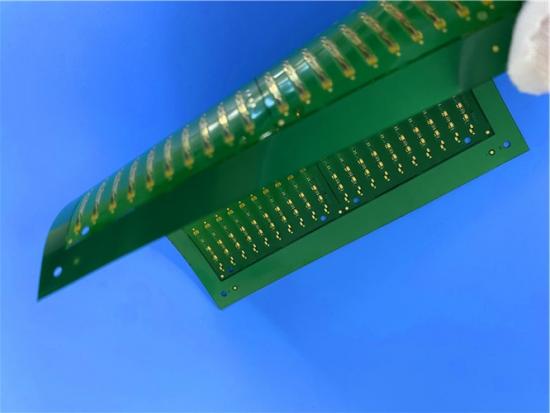
This 2-Layer Ultra-Thin Flexible Printed Circuit Board (FPC) is a high-performance, miniaturized, and bendable interconnect solution engineered for compact, weight-sensitive, and dynamically flexing electronic assemblies.
Item NO.:
BIC-552-v637.0Order(MOQ):
1-10Payment:
T/TProduct Origin:
ChinaShipping Port:
ShenzhenLead Time:
7-10 days
2-Layer Ultra-Thin Flexible Polyimide, Adhesiveless PCBSF202 ENEPIG Green Solder Mask
1. Product Overview
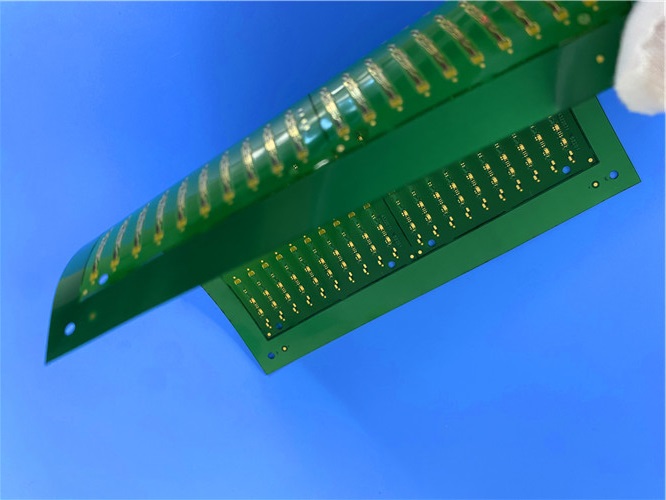
This 2-Layer Ultra-Thin Flexible Printed Circuit Board (FPC) is a high-performance, miniaturized, and bendable interconnect solution engineered for compact, weight-sensitive, and dynamically flexing electronic assemblies. Built on ultra-thin polyimide base material with a double-sided conductor layout, advanced ENEPIG surface finish, and green liquid solder mask, this FPC PCB delivers exceptional mechanical flexibility, electrical reliability, thermal stability, and chemical resistance. It is purpose-designed for portable electronics, wearable devices, automotive sensors, medical diagnostic tools, camera modules, display interfaces, and compact industrial controls where thin form factor, consistent flex performance, and long-term durability are non-negotiable.
Compared with rigid PCBs, this flexible circuit board supports 3D assembly, dynamic bending, twisting, and repeated folding without electrical or mechanical failure. Compared with standard-thickness FPCs, this ultra-thin version reduces overall device volume, lowers weight, improves heat dissipation, and enables tighter packaging in slim consumer and industrial products. Every board undergoes 100% electrical testing before shipment to guarantee zero electrical defects, stable impedance, reliable conduction, and full compliance with customer functional specifications and industry quality standards.
2. PCB Construction Details
This section summarizes the complete structural composition, material selection, and processing characteristics of the 2-layer ultra-thin FPC PCB, covering base material, layer structure, dimensions, copper type, surface treatment, solder mask, and quality verification.
|
Item |
Specification |
|
Base Material |
Polyimide (PI), 50 µm thickness |
|
Layer Count |
Double-sided (2 layers) |
|
Board Dimensions |
100 mm × 100 mm per piece |
|
Minimum Hole Size |
0.1 mm |
|
Blind Vias |
Not applicable (No blind vias) |
|
Finished Board Thickness |
0.118 mm |
|
Finished Copper Weight |
0.6 oz (≈21 µm) outer layers |
|
Copper Foil Type |
RA Copper (Rolled Annealed) |
|
Surface Finish |
ENEPIG (Electroless Nickel Immersion Palladium Gold) |
|
Top Silkscreen |
None |
|
Bottom Silkscreen |
None |
|
Top Solder Mask |
Green liquid solder mask ink |
|
Bottom Solder Mask |
Green liquid solder mask ink |
|
Quality Control |
100% electrical test before shipment |
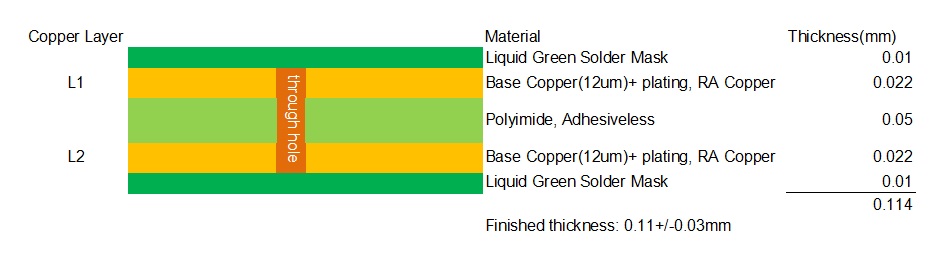
3. PCB Stackup
This stackup describes the layer sequence, material type, and thickness distribution from top to bottom, ensuring clarity of structural design and mechanical stability.
|
Layer |
Material |
Thickness (mm) |
|
L1 (Top) |
Liquid Green Solder Mask |
0.01 |
|
L1 (Top) |
Base Copper (12µm) + Plating, RA Copper |
0.022 |
|
Core |
Polyimide, Adhesiveless (SF202) |
0.05 |
|
L2 (Bottom) |
Base Copper (12µm) + Plating, RA Copper |
0.022 |
|
L2 (Bottom) |
Liquid Green Solder Mask |
0.01 |
|
Total |
Finished Thickness |
0.114 |
4. Key Material & Process Introduction
4.1 Copper Foil: ED Copper vs. RA Copper
Copper foil is the core conductive material in flexible circuits. Two dominant types are used in FPC manufacturing: Electrodeposited (ED) Copper and Rolled Annealed (RA) Copper.
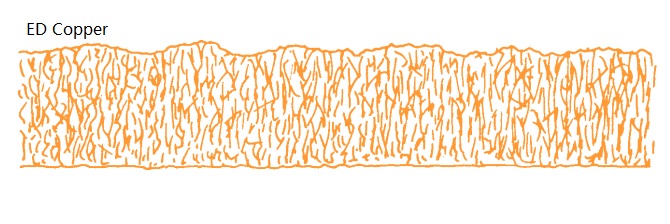
ED copper foil is produced through electrolytic deposition, the same process used for rigid PCB copper foils. One side of the foil is chemically treated to create a micro-rough surface, which improves bonding strength with dielectric substrates. Due to its vertical grain structure formed during electrolysis, ED copper has relatively low ductility and flex endurance. It is suitable for static-flex applications or fixed-installation FPCs that do not require repeated bending.
Typical thicknesses: 17.5 µm (0.5 oz), 35 µm (1 oz), 70 µm (2 oz), 105 µm (3 oz), 175 µm (5 oz).
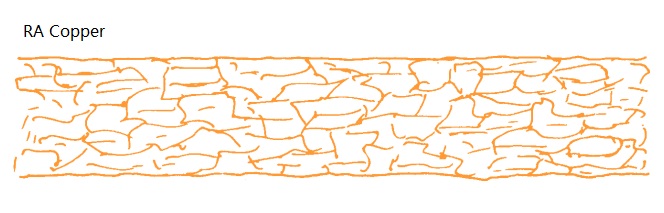
RA copper starts from electrolytic cathode copper that is melted, cast, hot-rolled, surface-milled, cold-rolled, and annealed repeatedly to reach target thickness. It features a horizontal grain structure, delivering far superior flexibility, flex life, and bending fatigue resistance compared with ED copper. RA copper is the preferred choice for dynamic-flex applications such as foldable screens, camera modules, wearable devices, and dynamic interconnects.
Although the bonding surface of RA copper is smoother and offers lower initial adhesion, special electrolytic flash treatment can strengthen bonding without reducing flex performance. Typical thicknesses match ED copper: 17.5, 35, 70, 105, 175 µm (0.5–5 oz).
This FPC uses RA copper to ensure excellent dynamic flex performance and long-term bending reliability.
4.2 Solder Mask: Film Coverlay vs. Liquid Solder Mask Ink
Flexible PCBs use two main protective insulation materials: coverlay film and liquid solder mask ink.
Film Coverlay
Usually a polyimide film coated with adhesive, laminated onto the FPC surface. It offers stable dielectric performance, good mechanical protection, and high chemical resistance. However, it is less suitable for ultra-fine circuits and high-precision openings.
Liquid Solder Mask Ink
A photosensitive liquid ink coated, exposed, and developed on the FPC surface. It enables finer feature definition, thinner coating, smoother surface, and better compatibility with high-density assembly. This product uses green liquid solder mask ink on both sides, providing ideal insulation, solderability, and appearance for thin, high-precision FPCs.
4.3 Surface Finish: ENEPIG
ENEPIG (Electroless Nickel / Immersion Palladium / Immersion Gold) is a high-reliability surface treatment for high-end FPCs.
5. Product Performance & Application Advantages
5.1 Ultra-Thin & Lightweight
Finished thickness only 0.118 mm, significantly reducing device size and weight for slim and portable designs.
5.2 Excellent Flexibility
RA copper foil and polyimide substrate support repeated bending, folding, and twisting without cracking or open circuits.
5.3 High Reliability
ENEPIG surface finish ensures stable contact, strong oxidation resistance, and long-term performance under harsh conditions.
5.4 Stable Electrical Performance
Low line resistance, stable dielectric properties, and 100% electrical test guarantee consistent signal integrity.
5.5 Good Thermal & Chemical Resistance
Polyimide base material withstands high reflow temperatures and resists common chemicals used in electronics manufacturing.
5.6 High Precision Machining
Minimum drill hole 0.1 mm supports high-density interconnection and miniaturized assembly.
This FPC is widely used in: smart phones, tablet PCs, wearable devices, medical instruments, automotive electronics, camera modules, display components, slim sensors, and industrial control equipment.
SF202 Adhesiveless Double-Sided FCCL (Base Material for This FPC)
1. Product Introduction
SF202 is a double-sided, adhesiveless flexible copper clad laminate (FCCL) developed by Shengyi Technology for high-end flexible circuits. It uses a polyimide film directly bonded with copper foil without adhesive layers, delivering superior heat resistance, dimensional stability, chemical resistance, and electrical performance compared with adhesive-based FCCL. It is halogen-free, flame-retardant to UL94 VTM-0, fully RoHS compliant, and ideal for high-reliability, ultra-thin, dynamic-flex FPCs.
2. Core Features
3. Typical Performance Properties (Complete Data Sheet Table)
|
Test Item |
Test Method |
Unit |
IPC Standard |
Typical Value (SF202 0512DT) |
|
90° Peel Strength |
IPC-TM650 2.4.9 Method A / C |
N/mm |
≥0.525 |
1.2 / 1.2 |
|
Thermal Stress |
IPC-TM-650 2.4.13 |
– |
Pass |
Pass |
|
Dimensional Stability |
IPC-TM-650 2.2.4 Method B |
% |
±0.2 |
MD:0.01 / TD:0 |
|
Chemical Resistance |
IPC-TM-650 2.3.2 |
% |
≥80 |
85 |
|
Moisture Absorption |
IPC-TM-650 2.6.2 |
% |
≤2 |
1.3 |
|
Volume Resistivity |
IPC-TM-650 2.5.17 |
MΩ·cm |
≥10⁶ |
4.8×10⁸ |
|
Surface Resistance |
IPC-TM-650 2.5.17 |
MΩ |
≥10⁵ |
1.2×10⁶ |
|
Dielectric Constant (1 GHz) |
IPC-TM-650 2.5.5.9 |
– |
– |
3.2 |
|
Dissipation Factor (1 GHz) |
IPC-TM-650 2.5.5.9 |
– |
– |
0.007 |
|
MIT Flex Endurance (R0.38×4.9N with CVL) |
– |
Times |
– |
>2000 |
|
Dielectric Strength |
IPC-TM-650 2.5.6.2 |
V/μm |
≥80 |
150 |
4. Standard Specifications
SF202 supports various PI thicknesses and copper foil types (RTF / RA / ED):
PI film thickness: 12.5, 20, 25, 50, 75, 100, 125 µm
Copper foil thickness: 3, 6, 9, 12, 18, 35, 45, 50, 70, 105 µm
Copper types: RTF (Reverse Treated Foil), RA (Rolled Annealed), ED (Electrodeposited)
Typical applications: camera modules, LCM, touch panels, battery boards, industrial control, medical devices, wireless charging, fine-line high-density FPC.
5. Packaging & Storage
Standard width: 250±2 mm or 500±2 mm
Standard length: 50±1 m or 100±2 m per roll
Custom sizes available upon request
Storage: dry, non-corrosive environment; 5–35℃, humidity≤75%; shelf life: 12 months in original packaging
6. Material Image Description
SF202 FCCL Appearance: Smooth, uniform polyimide dielectric layer with tightly bonded double-sided copper foil, flat surface, no wrinkles or bubbles.
RA Copper Foil Cross-Section Image: Shows uniform horizontal grain structure, high ductility, excellent flex life.
ED Copper Foil Cross-Section Image: Shows vertical grain structure, suitable for static flex applications.
Conclusion
By combining the engineering wisdom of RA copper for flexibility, liquid solder mask for ultra-thin profile protection, ENEPIG for universal solderability, and the SF202 adhesiveless polyimide for thermal and dimensional stability, we present an FPC that does not compromise. It is ready for the most demanding applications of today and tomorrow.
If you have questions or suggestions,please leave us a message,we will reply you as soon as we can!
Categories
New Products
10-Layer RO4350B + TU-768 Hybrid PCB with Via Copper Capped ENIG Surface Finish
8-Layer 6.6mil Rogers RO4350B + Isola I-Tera MT40 Hybrid PCB 1.636mm Pressed Thickness ENEPIG
6-Layer 5mil Rogers RO3003 Mixed-Laminated with Isola 370HR 0.82 mm Hybrid PCB with ENIG
4-Layer 8mil RO4003C + Tg170 FR-4 Hybrid PCB with ENIG — 0.556mm Thin Build
1100 × 350mm Long-Format Rogers RO4003C 32 mil core Double-Sided High-Frequency PCB
Wangling TP2200 PCB 0.8mm Substrate Immersion Gold 2-Layer High-Dk (Dk 22) RF Board
Rogers TMM10 PCB 5.08mm Core ENIG 2-Layer High-Dk Microwave Board
Taconic TLX-8 PCB 50mil ENIG 2-Layer High-Frequency RF Circuit Board
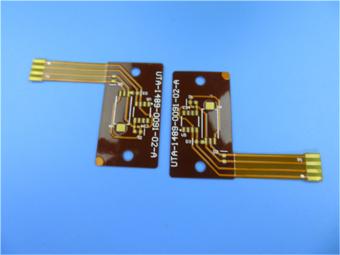
Flexible Printed Circuit Board (FPC) is referred to as "soft board". In the industry, FPC is a printed circuit board made of flexible insulating substrate (mainly polyimide or polyester film), which has many advantages that rigid printed circuit boards do not have.
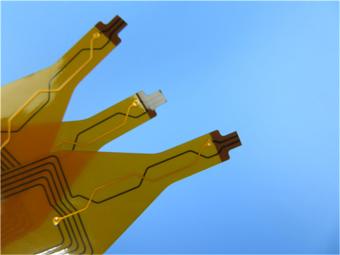
It’s a 2 layer flex board at 0.15mm thick. It contains yellow coverlay (solder mask) and without silkscreen on entire board, and immersion gold is applied on pads.

This is a type of flexible printed circuit for the application of Surveillance System. It’s a single layer FPC at 0.15mm thick.
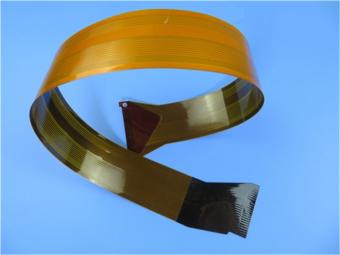
This is a type of single layer flexible printed circuit for the application of Wireless Dongle, 0.2mm thick.
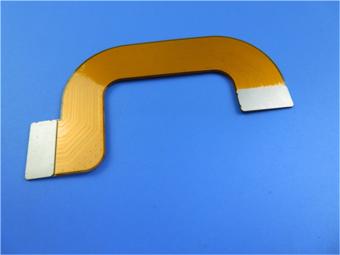
It’s fabricated per IPC 6012 Class 2 using supplied Gerber data. Stainless steel as stiffener is applied on the two ends.
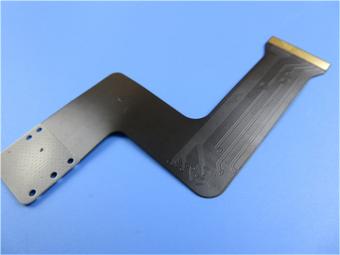
This is a type of flexible printed circuit for the application of PLC Programing.
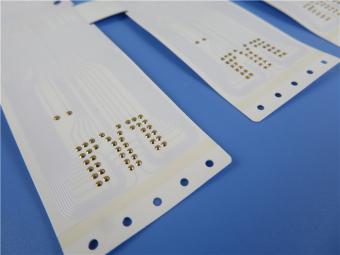
This is a type of dual layer flexible circuit built on PET substrate, 1oz copper weight on each layer.
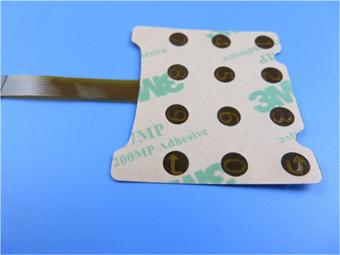
This type of flexible printed circuit is for the application of calculator keypad. It’s a single layer FPC at 0.15mm thick.
 6-11C Shidai Jingyuan, Fuyong, Baoan, Shenzhen, Guangdong, China 518103


For inquiries about our products or pricelist, please leave to us and we will be in touch within 24 hours.
© Copyright: 2026 Shenzhen Bicheng Electronics Technology Co., Ltd.. All Rights Reserved.

IPv6 network supported


