
 Call Us Now !
Tel : +86 755 27374946
 Order Online Now !
Email : info@bichengpcb.com
Blog
What the Datasheet Doesn’t Tell You About the 4-Layer WL-CT330 PCB? Meta Description: Discover why the 4-layer WL-CT330 PCB is a practical choice for RF and high-speed designs. We go beyond typical specs to explore hybrid stackup decisions, thermal reality, and cost-conscious DFM. When an RF engineer first looks at the datasheet for a 4-layer WL-CT330 PCB, the numbers jump out i...
TF600 PCB: When High-Frequency Designs Demand Ceramic-Filled PTFE In an age where every decibel of insertion loss and every degree of phase instability can determine the success of a wireless product, the choice of PCB material is no longer a secondary design decision. For RF and microwave engineers, FR-4 often becomes a bottleneck beyond 3 GHz—not because it fails outright, but because it ...
What makes TP2000 PCB outperform FR‑4 at 5GHz and radar applications? Meta Description: TP2000 PCB offers a uniqueultra-high dielectric constant (Dk=20) and ultra-low dissipation factor (Df=0.002) for compact RF and microwave designs. Learn why this thermoplastic material outperforms conventional laminates in antenna, radar, and satellite systems. When you first look at a TP2000 high fre...
Why Choose ENEPIG Finish Over Other Surface Finishes for a Double-Layer Rogers PCB? ENEPIG (Electroless Nickel Electroless Palladium Immersion Gold) is increasingly specified for high-performance PCBs, especially those combining RF materials like Rogers RO4003C with mixed-technology assemblies. In the double-layer board described earlier—featuring a 0.5mm RO4003C LoPro core, 1 oz copper, no bottom...
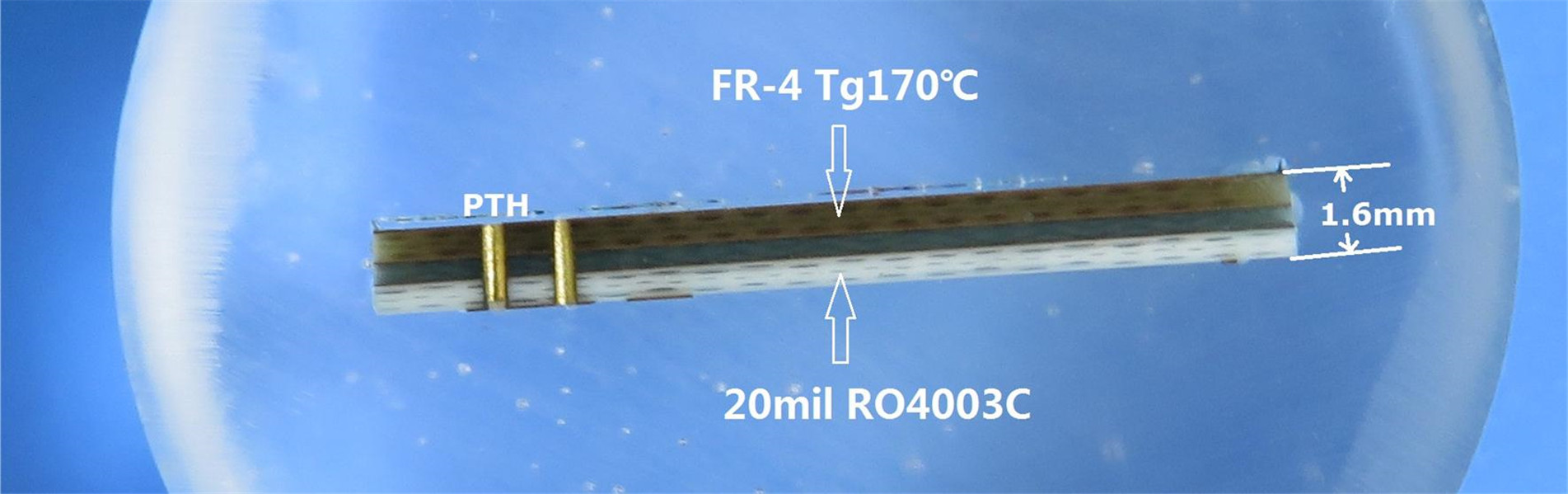
How Does Hybrid Stackup of AD250C and FR-4 Balance RF Performance and Structural Integrity? In the realm of high-frequency printed circuit board design, engineers are often forced to make compromises. On one hand, RF performance demands low-loss materials with stable dielectric constants. On the other, mechanical reliability and cost-effectiveness call for conventional materials like FR-4. Strikin...
How Does Nickel-Free EPIG Improve PIM Performance in Base Station Antennas? Passive Intermodulation (PIM) is one of the most critical performance killers in modern cellular infrastructure. In a base station antenna system, PIM appears as unwanted interference generated by passive components—connectors, cables, and the printed circuit board itself—when two or more high-power transmit signals mix. E...
What Makes DiClad 870’s Low Dk and DF Critical for Radar and Antenna Designs? In high-frequency printed circuit boards, the choice of dielectric material is not merely a matter of mechanical support—it directly governs signal integrity, insertion loss, and phase stability. For radar systems, antenna feed networks, and other RF applications, two material parameters stand out above all: dielectric c...
How Does RT/duroid 6010.2LM’s High Dk Enable Circuit Miniaturization in 4-Layer PCBs? In the world of high-frequency RF and microwave engineering, the mantra is often "smaller, faster, cheaper." However, achieving miniaturization without compromising signal integrity is a significant challenge. As operating frequencies push into the X-band and beyond, the physical dimensions of passive stru...
How the Low DK and DF of TLX-7 Improve RF Signal Integrity in High-Frequency PCBs? In the world of RF (Radio Frequency) and microwave engineering, the PCB is not just a holder for components; it is a critical component of the circuit itself. As we push into higher frequencies (into the mmWave range), the margin for error shrinks dramatically. Every material property, every trace width, and ...
What is the Dk and Df of the F4BTMS615 Material at 10 GHz? In the world of RF (Radio Frequency) and microwave engineering, the substrate material upon which a circuit is printed is not merely a passive carrier; it is an active participant in the circuit's performance. When designing for frequencies in the GHz range, two material parameters rise above all others in importance: the Diele...
Categories
New Blog
Tags
 6-11C Shidai Jingyuan, Fuyong, Baoan, Shenzhen, Guangdong, China 518103


For inquiries about our products or pricelist, please leave to us and we will be in touch within 24 hours.
© Copyright: 2026 Shenzhen Bicheng Electronics Technology Co., Ltd.. All Rights Reserved.

IPv6 network supported


