
 Call Us Now !
Tel : +86 755 27374946
 Order Online Now !
Email : info@bichengpcb.com
Why Choose 10mil Rogers 5880LZ for High-Frequency, Low-Loss PCB Designs? In the competitive landscape of RF and microwave engineering, selecting the optimal PCB substrate is a foundational decision that directly impacts performance, reliability, and system success. Among high-performance materials, Rogers RT/duroid 5880LZ stands out, particularly in the 10mil (0.254mm) thickness variant for d...
Why Choose Rogers CuClad 217 for High-Frequency PCBs? A Look at Dk, Df, and Isotropy Selecting the right laminate is a primary decision in high-frequency PCB development. Standard materials like FR-4 are not suitable when signal integrity is required above 500 MHz. For radar systems, aerospace communications, or microwave components, the substrate material directly affects circui...
How Does RT/duroid 6010.2LM’s High Dk Enable Circuit Miniaturization in 4-Layer PCBs? In the world of high-frequency RF and microwave engineering, the mantra is often "smaller, faster, cheaper." However, achieving miniaturization without compromising signal integrity is a significant challenge. As operating frequencies push into the X-band and beyond, the physical dimensions of passive stru...
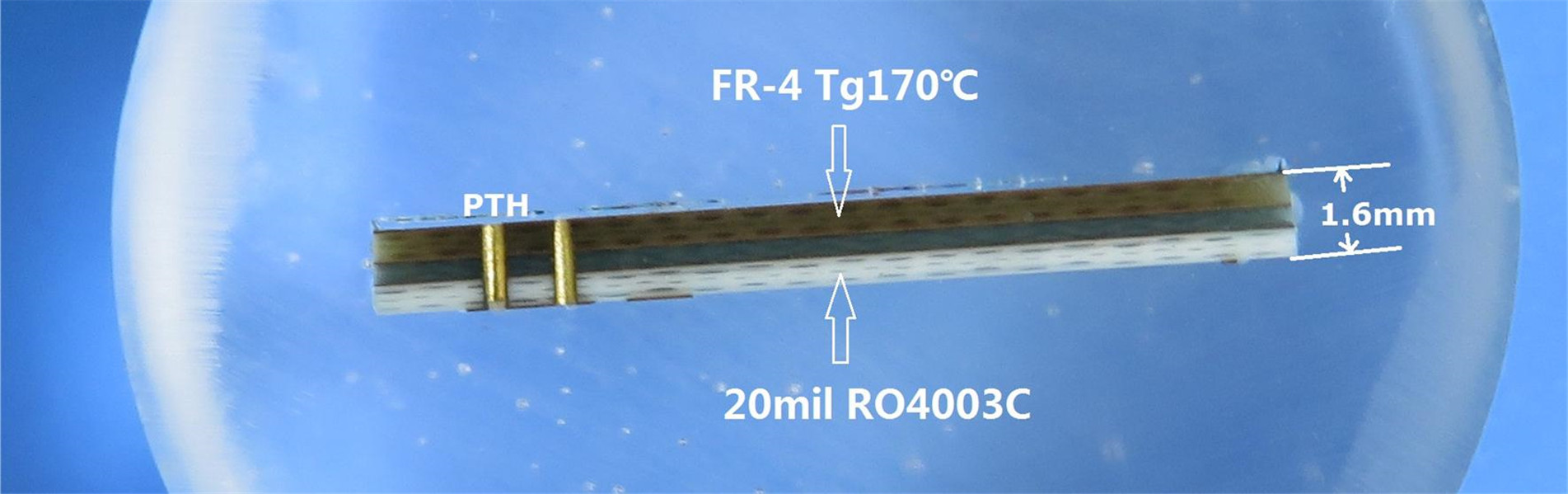
How Does Hybrid Stackup of AD250C and FR-4 Balance RF Performance and Structural Integrity? In the realm of high-frequency printed circuit board design, engineers are often forced to make compromises. On one hand, RF performance demands low-loss materials with stable dielectric constants. On the other, mechanical reliability and cost-effectiveness call for conventional materials like FR-4. Strikin...
What the Datasheet Doesn’t Tell You About the 4-Layer WL-CT330 PCB? Meta Description: Discover why the 4-layer WL-CT330 PCB is a practical choice for RF and high-speed designs. We go beyond typical specs to explore hybrid stackup decisions, thermal reality, and cost-conscious DFM. When an RF engineer first looks at the datasheet for a 4-layer WL-CT330 PCB, the numbers jump out i...
Why Use WL-CT440 Instead of FR4 or PTFE for 2-Layer RF PCBs? When designing a 2-layer PCB for high-frequency RF applications—such as phased array antennas, airborne radar, or satellite communications—the choice of dielectric material is arguably the most consequential decision after the schematic itself. At frequencies above 1 GHz, the PCB substrate ceases to be a passive mechanical carrier a...
Categories
New Blog
Tags
 6-11C Shidai Jingyuan, Fuyong, Baoan, Shenzhen, Guangdong, China 518103


For inquiries about our products or pricelist, please leave to us and we will be in touch within 24 hours.
© Copyright: 2026 Shenzhen Bicheng Electronics Technology Co., Ltd.. All Rights Reserved.

IPv6 network supported


