
 Call Us Now !
Tel : +86 755 27374946
Call Us Now !
Tel : +86 755 27374946
 Order Online Now !
Email : info@bichengpcb.com
Order Online Now !
Email : info@bichengpcb.com
What Makes DiClad 870’s Low Dk and DF Critical for Radar and Antenna Designs? In high-frequency printed circuit boards, the choice of dielectric material is not merely a matter of mechanical support—it directly governs signal integrity, insertion loss, and phase stability. For radar systems, antenna feed networks, and other RF applications, two material parameters stand out above all: dielectric c...
How Does Nickel-Free EPIG Improve PIM Performance in Base Station Antennas? Passive Intermodulation (PIM) is one of the most critical performance killers in modern cellular infrastructure. In a base station antenna system, PIM appears as unwanted interference generated by passive components—connectors, cables, and the printed circuit board itself—when two or more high-power transmit signals mix. E...
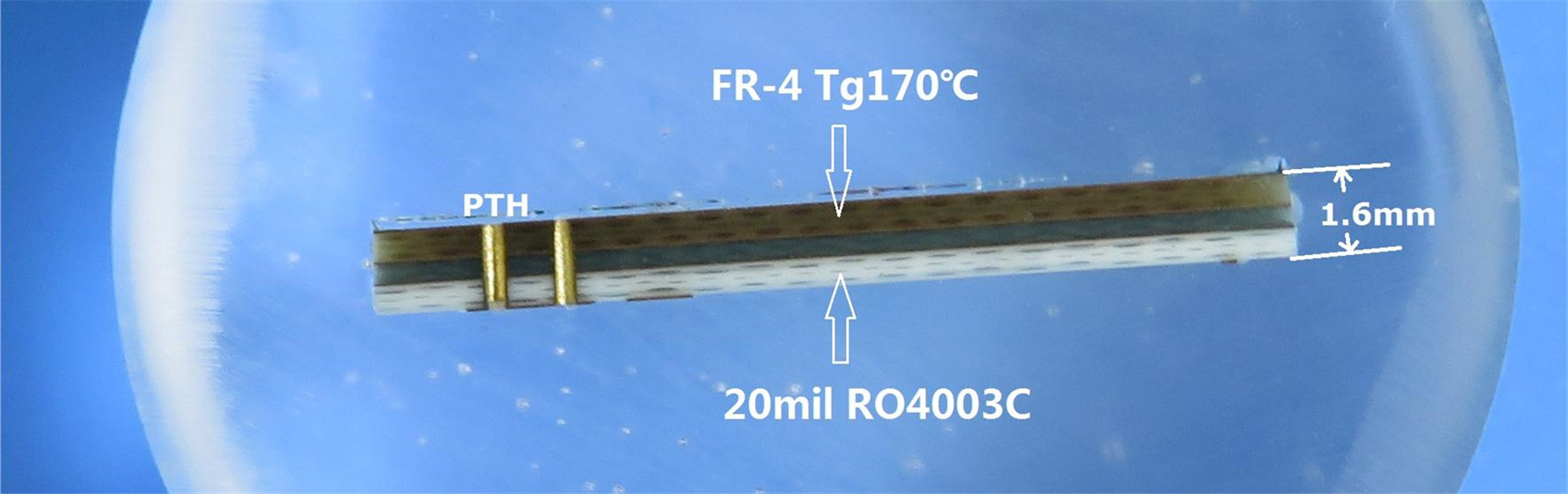
How Does Hybrid Stackup of AD250C and FR-4 Balance RF Performance and Structural Integrity? In the realm of high-frequency printed circuit board design, engineers are often forced to make compromises. On one hand, RF performance demands low-loss materials with stable dielectric constants. On the other, mechanical reliability and cost-effectiveness call for conventional materials like FR-4. Strikin...
Why Choose ENEPIG Finish Over Other Surface Finishes for a Double-Layer Rogers PCB? ENEPIG (Electroless Nickel Electroless Palladium Immersion Gold) is increasingly specified for high-performance PCBs, especially those combining RF materials like Rogers RO4003C with mixed-technology assemblies. In the double-layer board described earlier—featuring a 0.5mm RO4003C LoPro core, 1 oz copper, no bottom...
What makes TP2000 PCB outperform FR‑4 at 5GHz and radar applications? Meta Description: TP2000 PCB offers a uniqueultra-high dielectric constant (Dk=20) and ultra-low dissipation factor (Df=0.002) for compact RF and microwave designs. Learn why this thermoplastic material outperforms conventional laminates in antenna, radar, and satellite systems. When you first look at a TP2000 high fre...
TF600 PCB: When High-Frequency Designs Demand Ceramic-Filled PTFE In an age where every decibel of insertion loss and every degree of phase instability can determine the success of a wireless product, the choice of PCB material is no longer a secondary design decision. For RF and microwave engineers, FR-4 often becomes a bottleneck beyond 3 GHz—not because it fails outright, but because it ...
Categories
New Blog
Tags
 6-11C Shidai Jingyuan, Fuyong, Baoan, Shenzhen, Guangdong, China 518103


For inquiries about our products or pricelist, please leave to us and we will be in touch within 24 hours.
© Copyright: 2026 Shenzhen Bicheng Electronics Technology Co., Ltd.. All Rights Reserved.

IPv6 network supported


