
 Call Us Now !
Tel : +86 755 27374946
Call Us Now !
Tel : +86 755 27374946
 Order Online Now !
Email : info@bichengpcb.com
Order Online Now !
Email : info@bichengpcb.com
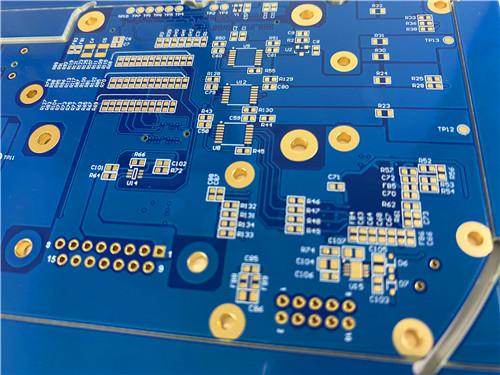
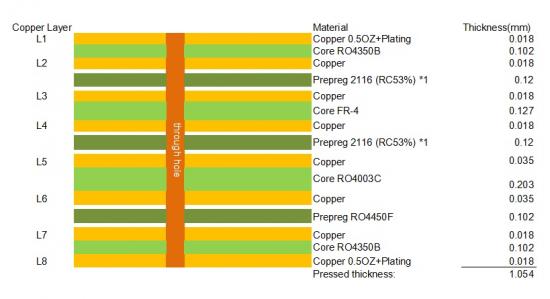
This 8-layer hybrid ENIG PCB represents a thoughtful integration of high-frequency Rogers materials with high-Tg FR-4, delivering microwave-grade performance where it matters most while maintaining cost efficiency and mechanical reliability.
Item NO.:
BIC-624-v709Order(MOQ):
1-10Payment:
T/TProduct Origin:
ChinaShipping Port:
ShenzhenLead Time:
7-10 days
8-Layer Hybrid RF PCB: RO4350B + TG170 FR-4 + RO4003C with RO4450F Bondply
This 8-layer hybrid circuit board represents a carefully engineered stackup that combines high-frequency Rogers laminates with a high-Tg FR-4 core, delivering microwave-grade RF performance on outer and critical inner layers while maintaining cost efficiency and mechanical robustness in the signal and power distribution layers. At a finished thickness of 1.054 mm and a compact footprint of 110 mm x 83 mm, the board is designed for high-density RF front-end modules, power amplifier assemblies, and microwave transceiver subsystems where signal integrity, thermal management, and long-term reliability are non-negotiable.
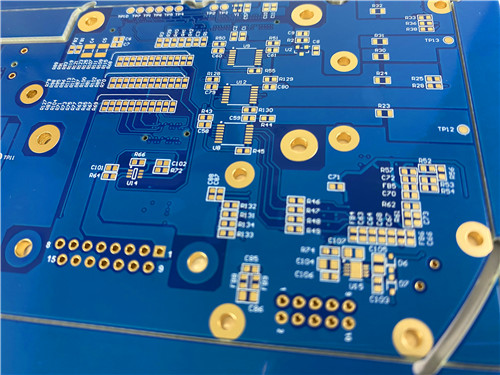
The construction uses 4 mil RO4350B on both the top and bottom outer layers, an 8 mil RO4003C core in the middle, a TG170 FR-4 layer for structural support, and 4 mil RO4450F bondply for interlayer adhesion. Copper weights are differentiated — 1 oz on outer layers for improved current carrying and solderability, and 0.5 oz on inner layers for fine-line routing and impedance control. The board is finished with electroless nickel immersion gold (ENIG), features a black silkscreen on the top side with no solder mask, and a blue solder mask on the bottom with no silkscreen. Every unit undergoes 100% electrical testing and is manufactured to IPC Class 3 acceptance standards.
The following table summarizes the complete construction specification of this 8-layer hybrid PCB, covering material composition, dimensional parameters, copper weights, surface finishing, and quality acceptance criteria.
|
Parameter |
Specification |
|
Base Material |
Hybrid — RO4350B / TG170 FR-4 / RO4003C / RO4450F |
|
Layer Count |
8 layers |
|
Board Dimensions |
110 mm x 83 mm = 1 PCS, +/- 0.15 mm |
|
Finished Board Thickness |
1.054 mm (after lamination) |
|
Finished Cu Weight |
1 oz outer layers / 0.5 oz inner layers |
|
Via Plating Thickness |
25 um |
|
Surface Finish |
Immersion Gold (ENIG) |
|
Top Silkscreen |
Yes — Black |
|
Bottom Silkscreen |
No |
|
Top Solder Mask |
No |
|
Bottom Solder Mask |
Blue |
|
Blind Vias |
None |
|
Acceptance Standard |
IPC Class 3 |
|
Electrical Test |
100% tested prior to shipment |
Table 1: PCB Construction Details
The layer stackup is the defining feature of this hybrid design, strategically placing high-frequency materials where RF performance matters most while using FR-4 for cost-effective structural and power layers. The table below presents the material composition from top to bottom, including dielectric thicknesses and copper weights for each signal layer.
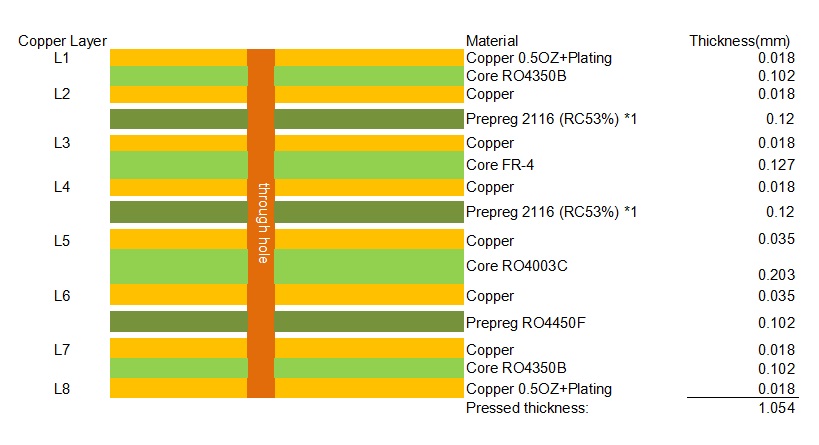
Table 2: PCB Layer Stackup
The use of Rogers RO4350B on both outer surfaces is deliberate. With a dielectric constant of 3.48 +/- 0.05 at 10 GHz and a dissipation factor of just 0.0037, RO4350B provides a stable, low-loss substrate for surface-mounted RF components, microstrip transmission lines, and antenna feed networks. Its tight Dk tolerance — approximately +/- 1.4% compared to the +/- 5-10% typical of standard FR-4 — means that impedance-controlled lines can be designed with greater confidence, reducing the need for design margins that consume board area.
The 8 mil RO4003C core in the middle of the stackup serves as the primary high-frequency signal layer. RO4003C offers an even lower dissipation factor of 0.0027 at 10 GHz and a Dk of 3.38 +/- 0.05, making it well-suited for stripline routing of sensitive microwave signals. Its thermal conductivity of 0.71 W/m.K is among the highest in the RO4000 family, helping to dissipate heat from power amplifiers and other heat-generating components mounted on the board. The 8 mil thickness provides a robust mechanical core while allowing for controlled impedance stripline geometries.
TheTG170 FR-4 layer plays a critical supporting role. With a glass transition temperature of 170 degrees C, this high-Tg FR-4 provides excellent dimensional stability during multiple lamination cycles and lead-free reflow soldering, where peak temperatures can reach 260 degrees C. It also serves as a cost-effective substrate for non-critical signal routing, power distribution planes, and ground references, reducing overall material cost compared to an all-Rogers construction. The combination of high-Tg FR-4 with Rogers laminates is a proven approach in hybrid PCB design, leveraging the strengths of each material system.
The 4 mil RO4450F bondply is the adhesive that holds this multi-material stack together. Unlike standard FR-4 prepreg, RO4450F is a hydrocarbon-ceramic bondply specifically engineered for use with RO4000 series laminates. Its dielectric constant of 3.52 +/- 0.05 is closely matched to the surrounding RO4350B and RO4003C materials, minimizing impedance discontinuities at layer transitions. With a post-cure Tg exceeding 280 degrees C, RO4450F can withstand sequential lamination cycles without reflow or degradation, a critical requirement for 8-layer constructions that may require multiple press cycles. Its lateral flow capability ensures complete resin fill between copper features, reducing the risk of voids and delamination.
This hybrid PCB is manufactured to IPC Class 3 standards, the highest acceptance class defined by IPC-A-600, intended for products where continued performance and on-site failure cannot be tolerated. This means tighter tolerances on hole wall quality, copper thickness, annular ring, and cosmetic defects compared to Class 1 or Class 2 products.
The ENIG surface finish provides a flat, solderable surface with excellent shelf life and wire-bonding capability, making it suitable for fine-pitch components and BGA packages. The top side's absence of solder mask (bare copper with ENIG) is typical for RF boards where solder mask dielectric loss could degrade high-frequency performance, and where components may require direct grounding or thermal contact to the board surface. The black silkscreen on the top provides component reference designators and assembly markings without affecting RF performance.
Every board undergoes 100% electrical testing prior to shipment, ensuring that all nets are continuous and that there are no opens or shorts. This level of testing, combined with IPC Class 3 acceptance criteria, provides a high degree of confidence in board quality and reliability.
This 8-layer hybrid PCB is well-suited for a range of high-frequency applications including:
Its combination of low-loss materials, controlled impedance, thermal management, and Class 3 reliability makes it a versatile platform for demanding RF and microwave designs.
This 8-layer hybrid ENIG PCB represents a thoughtful integration of high-frequency Rogers materials with high-Tg FR-4, delivering microwave-grade performance where it matters most while maintaining cost efficiency and mechanical reliability.
The strategic use of RO4350B on outer layers, RO4003C as the central core, TG170 FR-4 for structural support, and RO4450F bondply for interlayer adhesion creates a stackup that is both electrically optimized and manufacturably sound. With IPC Class 3 quality standards, 100% electrical testing, ENIG surface finish, and 25 um via plating, this board is engineered for reliability in the most demanding RF and microwave applications.
Part 2: RO4000 Series Material Knowledge
The Rogers RO4000 series is a family of glass-reinforced hydrocarbon/ceramic laminates and bondplys designed for high-frequency commercial applications. Unlike PTFE-based microwave materials, RO4000 series products combine the electrical performance of PTFE/glass with the manufacturability of epoxy/glass (FR-4), allowing them to be processed using standard PCB fabrication equipment without special through-hole treatments or handling procedures. This manufacturability advantage, combined with consistent electrical properties, has made the RO4000 series a standard choice for high-volume RF and microwave PCB production.
The RO4000 series includes several laminate grades — RO4003C, RO4350B, RO4360G2, RO4835, and others — each optimized for specific dielectric constant, loss, and thermal performance requirements. Complementing these laminates is the RO4400 series of bondplys, including RO4450F and RO4460G2, which are specifically formulated to be compatible with RO4000 laminates in multilayer constructions. The RO4400 bondply family is comprised of several grades based on the RO4000 series core materials, and a high post-cure Tg makes them an excellent choice for multilayers requiring sequential laminations, as fully cured RO4400 bondplys are capable of handling multiple lamination cycles.
RO4450F is a hydrocarbon-ceramic bondply based on the RO4000 series core material system, designed specifically for bonding RO4000 series laminates in multilayer PCB constructions. It is reinforced with 1080 glass fabric and has a resin content of 80%, giving it excellent lateral flow capability during lamination. This improved flow makes RO4450F the preferred choice for new designs and as a replacement in designs that have historically experienced difficult lamination, such as those with high copper density or uneven layer topography.
A key advantage of RO4450F is its high post-cure glass transition temperature of greater than 280 degrees C. This high Tg means that fully cured RO4450F bondply can withstand multiple lamination cycles without reflow or degradation, making it an excellent choice for multilayer constructions requiring sequential lamination. This is particularly important for 8-layer and higher layer count boards, where sequential lamination may be necessary to achieve the desired stackup.
RO4450F also offers FR-4 compatible bond requirements, permitting RO4450F bondply and low-flow FR-4 bondply to be combined into non-homogeneous multilayer constructions using a single bond cycle. This compatibility is what enables the hybrid stackup of this PCB, where RO4450F is used alongside TG170 FR-4 in the same lamination cycle. The standard thickness of RO4450F is 0.0040 inch (0.102 mm) +/- 0.0006 inch, and it is available in panel sizes ranging from 16 x 18 inch (406 x 457 mm) to 24 x 36 inch (610 x 915 mm). Each 4 mil ply bonds to approximately 0.004 inch (0.101 mm) when pressed between flat opposing surfaces, though the actual thickness added to a multilayer construction depends on copper weight and distribution.
The following table presents the complete electrical, thermal, mechanical, and physical properties of RO4450F bondply as specified in the official Rogers datasheet, including test conditions and test methods for each parameter.
|
Property |
Value |
Dir. |
Units |
Test Conditions |
Test Method |
|
ELECTRICAL PROPERTIES |
|
|
|
|
|
|
Dielectric Constant |
3.52 +/- 0.05 |
Z |
— |
23C @ 50% RH, 10 GHz |
IPC TM-650 2.5.5.5 |
|
Dissipation Factor |
0.004 |
Z |
— |
23C @ 50% RH, 10 GHz |
IPC TM-650 2.5.5.5 |
|
Volume Resistivity |
8.93 x 10^8 |
— |
Mohm-cm |
C-96/35/90 |
IPC TM-650 2.5.17.1 |
|
Surface Resistivity |
1.03 x 10^7 |
X,Y |
Mohm |
C-96/35/90 |
IPC TM-650 2.5.17.1 |
|
Electrical Strength |
1000 |
Z |
V/mil |
D-48/50 |
IPC TM-650 2.5.6.2 |
|
THERMAL PROPERTIES |
|
|
|
|
|
|
Decomposition Temp (Td) |
390 |
— |
C |
2 hrs @ 105C, 5% wt loss |
IPC TM-650 2.3.40 |
|
Glass Transition (Tg) |
>280 |
— |
C |
TMA |
IPC-TM-650 2.4.24.5 |
|
CTE (X-axis) |
19 |
X |
ppm/C |
-55C to 288C |
IPC TM-650 2.4.41 |
|
CTE (Y-axis) |
17 |
Y |
ppm/C |
-55C to 288C |
IPC TM-650 2.4.41 |
|
CTE (Z-axis) |
50 |
Z |
ppm/C |
-55C to 288C |
IPC TM-650 2.4.41 |
|
Thermal Conductivity |
0.65 |
Z |
W/(m.K) |
80C |
ASTM D5470 |
|
MECHANICAL PROPERTIES |
|
|
|
|
|
|
Cu Peel Strength (after stress) |
0.70 (4.0) |
Z |
N/mm (lbs/in) |
10s @ 288C, 35um foil |
IPC TM-650 2.4.8 |
|
PHYSICAL PROPERTIES |
|
|
|
|
|
|
Glass Style |
1080 |
— |
— |
— |
— |
|
Resin Content |
80 |
— |
% |
— |
— |
|
Color |
White |
— |
— |
— |
— |
|
Flammability |
V-0 |
— |
— |
C48/23/50 & C168/70 |
UL 94 |
|
Moisture Absorption |
0.04 |
— |
% |
D24/23 |
IPC TM-650 2.6.2.1 |
|
Lead-Free Process Compatible |
Yes |
— |
— |
— |
— |
Table 3: RO4450F Bondply Complete Datasheet (Source: Rogers Corporation)
In addition to the property table above, RO4450F is available in the following standard thicknesses and panel sizes, with additional configurations available upon request.
|
Standard Thicknesses |
Standard Panel Sizes |
|
0.0040" (0.102 mm) +/- 0.0006" |
16" x 18" (406 x 457 mm); 24" x 18" (610 x 457 mm); 24.5" x 18.5" (622 x 470 mm); 24" x 36" (610 x 915 mm) |
Table 4: RO4450F Standard Thicknesses and Panel Sizes
RO4350B is a glass-reinforced hydrocarbon/ceramic laminate designed for high-volume, high-performance commercial RF applications. It offers a dielectric constant of 3.48 +/- 0.05 at 10 GHz (with a design Dk of 3.66 at 2.5 GHz to account for process variations) and a dissipation factor of 0.0037 at 10 GHz. Its tight Dk tolerance of approximately +/- 1.4% is a significant advantage over standard FR-4, which typically exhibits +/- 5-10% Dk variation, enabling more precise impedance control in RF designs.
Thermally, RO4350B features a Tg of greater than 280 degrees C, a decomposition temperature of 390 degrees C, and a thermal conductivity of 0.69 W/m.K at 80 degrees C. Its coefficients of thermal expansion are 10 ppm/C (X-axis), 12 ppm/C (Y-axis), and 32 ppm/C (Z-axis) from -55C to 288C, closely matching copper's CTE and minimizing thermal stress on plated through-holes. RO4350B is UL 94 V-0 rated and has a moisture absorption of just 0.05%, ensuring stable electrical performance in humid environments. Available at a fraction of the cost of conventional microwave laminates, RO4350B does not require the special through-hole treatments or handling procedures associated with PTFE-based materials.
In this PCB, RO4350B is used on both the top and bottom outer layers at 4 mil thickness, providing a low-loss, high-stability substrate for surface-mounted RF components and microstrip transmission lines.
RO4003C is a woven-glass-reinforced hydrocarbon/ceramic laminate that offers the electrical performance of PTFE/woven glass with the manufacturability of epoxy/glass. It features a dielectric constant of 3.38 +/- 0.05 and an exceptionally low dissipation factor of 0.0027 at 10 GHz — the lowest in the RO4000 laminate family — making it ideal for the most loss-sensitive microwave and mmWave applications.
RO4003C utilizes both 1080 and 1674 glass fabric styles, with all configurations meeting the same laminate electrical performance specification. Its thermal conductivity of 0.71 W/m.K is the highest among RO4000 series laminates, providing superior heat dissipation for high-power RF circuits. The material has a Tg of greater than 280 degrees C, a decomposition temperature of 425 degrees C, and an X-axis CTE of 11 ppm/C. Like RO4350B, RO4003C requires no special through-hole treatments and is fully compatible with standard FR-4 PCB fabrication processes. Unlike PTFE-based microwave materials, no special through-hole treatments or handling procedures are required, and standard epoxy-glass-level bonding methods are widely permissible.
In this PCB, RO4003C is used as an 8 mil thick central core, serving as the primary high-frequency signal layer for stripline routing of sensitive microwave signals. Its low loss and high thermal conductivity make it the optimal choice for this critical layer position.
The RO4000 series of high-frequency laminates and bondplys represents a mature, well-characterized material platform that enables the construction of high-performance hybrid PCBs like the 8-layer design described in thisarticle.
RO4350B provides a balanced combination of low loss, tight Dk tolerance, and manufacturability for outer-layer RF circuits;
RO4003C offers the lowest dissipation factor (0.0027 at 10 GHz) and highest thermal conductivity (0.71 W/m.K) in the laminate family for critical inner-layer signal routing; and RO4450F bondply delivers reliable interlayer adhesion with matched electrical properties (Dk 3.52 +/- 0.05) and high-Tg stability (>280C) for sequential lamination.
Together with TG170 FR-4 for structural support, these materials form a stackup that is electrically optimized, thermally robust, and mechanically reliable — a proven solution for demanding RF and microwave applications.
Previous:
4-Layer 8mil RO4003C + Tg170 FR-4 Hybrid PCB with ENIG — 0.556mm Thin BuildNext:
4-Layer 10mil RO3003 + Tg170 FR-4 Hybrid PCB with ENIG and Controlled Depth MillingIf you have questions or suggestions,please leave us a message,we will reply you as soon as we can!
Categories
New Products
10-Layer RO4350B + TU-768 Hybrid PCB with Via Copper Capped ENIG Surface Finish
8-Layer 6.6mil Rogers RO4350B + Isola I-Tera MT40 Hybrid PCB 1.636mm Pressed Thickness ENEPIG
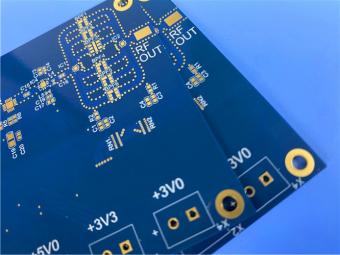
6-Layer 5mil Rogers RO3003 Mixed-Laminated with Isola 370HR 0.82 mm Hybrid PCB with ENIG
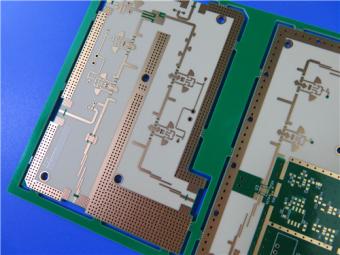
4-Layer 8mil RO4003C + Tg170 FR-4 Hybrid PCB with ENIG — 0.556mm Thin Build
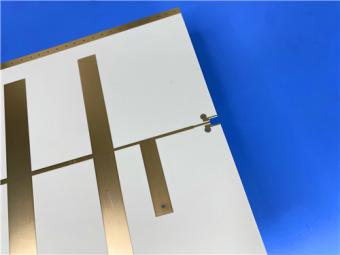
1100 × 350mm Long-Format Rogers RO4003C 32 mil core Double-Sided High-Frequency PCB
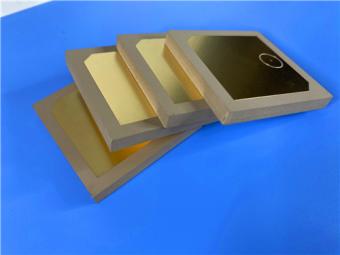
Wangling TP2200 PCB 0.8mm Substrate Immersion Gold 2-Layer High-Dk (Dk 22) RF Board
Rogers TMM10 PCB 5.08mm Core ENIG 2-Layer High-Dk Microwave Board
Taconic TLX-8 PCB 50mil ENIG 2-Layer High-Frequency RF Circuit Board
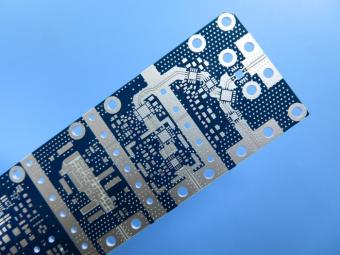
RO4003C exhibit a stable dielectric constant over a broad frequency range. This makes it an ideal substrate for broadband applications. And signal integrity performance improvement over the stack-ups with all FR4 board.
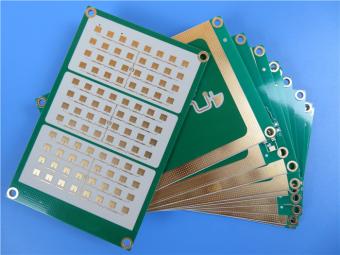
The hybrid PCB can be a mixture of FR-4 and high frequency material, and a mixture of high frequency material with different dielectric constant (DK)
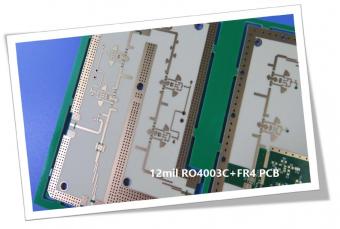
The 12mil core is on the top layer and it mainly plays the roles of signal layer. The core has fixed thickness which is very important to the electrical length of RF lines on the circuit board.
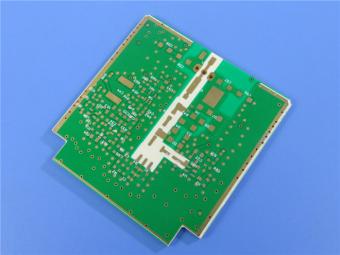
The hybrid PCB can be a mixture of FR-4 and high frequency material as abovementioned.
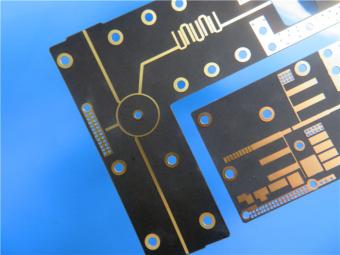
It contains 2 different boards in the panel. PCB boards are manufactured strictly as per required specifications with the standard IPC-Class-II.
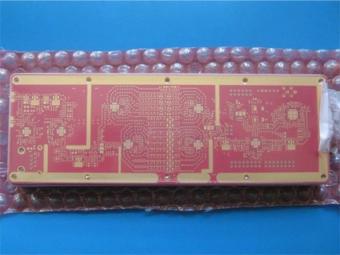
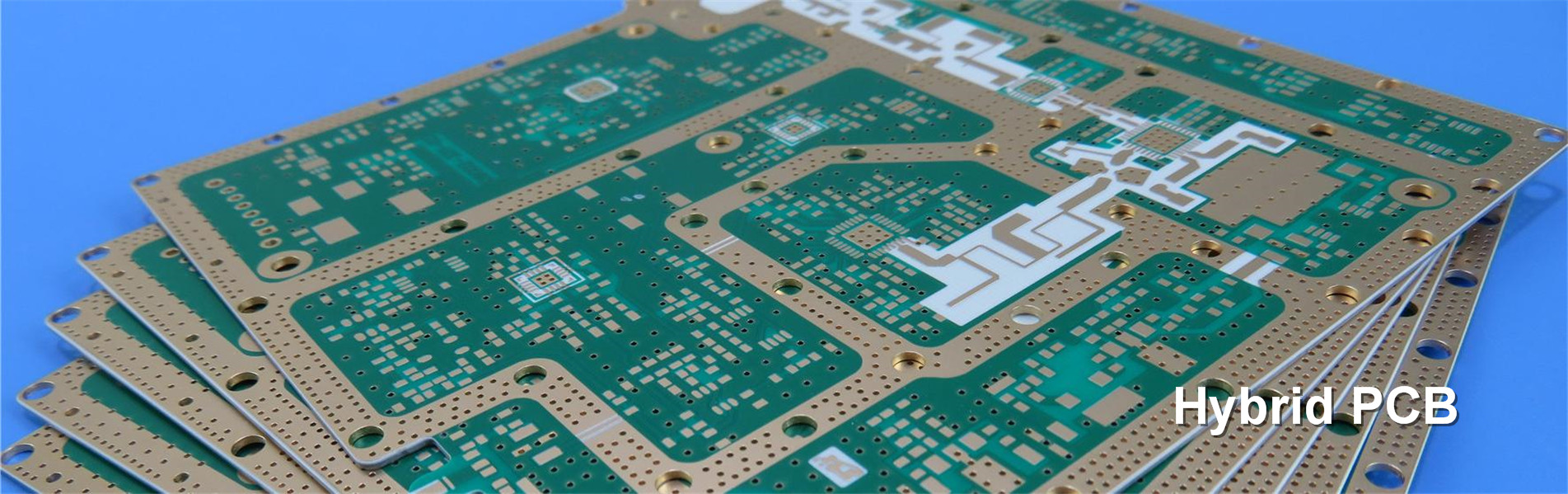
Hybrid PCB is also known as mixed material lamination, it’s normally combined by two different material like FR4 and PI(rigid flex PCB), FR4 and Ceramic, FR4 and Teflon, FR4 and Aluminum base etc.
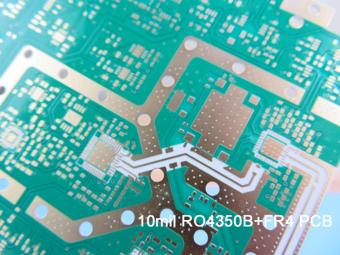
Hybrid constructions PCB typically involve a low loss material such as Nelco or Rogers combined with another core material like FR-4.
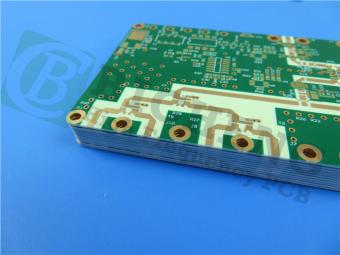
The Hybrid PCB on RO3003 and High Tg FR-4 is a state-of-the-art solution for high-frequency applications. With its exceptional stability, reliability, and manufacturability, it caters to the demands of industries such as automotive, telecommunications, and satellite communications.
 6-11C Shidai Jingyuan, Fuyong, Baoan, Shenzhen, Guangdong, China 518103


For inquiries about our products or pricelist, please leave to us and we will be in touch within 24 hours.
© Copyright: 2026 Shenzhen Bicheng Electronics Technology Co., Ltd.. All Rights Reserved.

IPv6 network supported


